

How to Install a Window Air Conditioner: Step-by-Step Guide
Learn how to install a window air conditioner with our step-by-step guide. Covers prep, fitting, sealing, and when to call a professional instead.


Learn how to install a window air conditioner with our step-by-step guide. Covers prep, fitting, sealing, and when to call a professional instead.
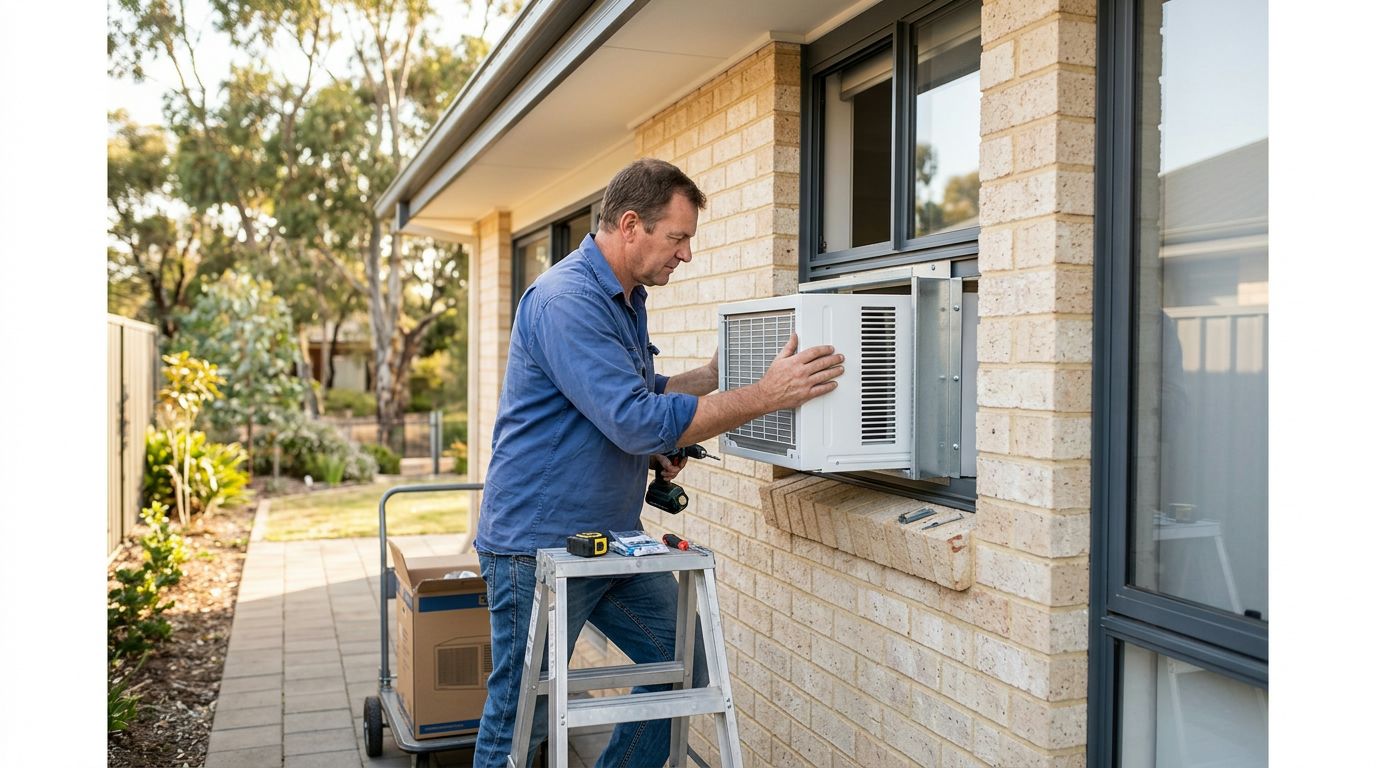
Yes, you can legally install a window air conditioner yourself in Australia. Unlike split systems, which require a licensed technician to handle refrigerant, a window unit arrives pre-charged and sealed. That means no refrigerant work is involved, and no ARC licence is needed. If you want to install an air conditioner window unit safely and correctly, this guide walks you through every step from choosing the right window to sealing the gaps and powering it up.
That said, 'legal' and 'straightforward' are not the same thing. Window units are heavy, awkward to lift and can cause serious damage to your window frame or wall if fitted incorrectly. There are also electrical requirements to check before you plug anything in.
Key takeaways
Good preparation is what separates a clean, safe installation from a leaking, rattling unit that trips your breaker on the first hot day. Before you touch the air conditioner, sort out your window, your power supply and your tools.
Start by measuring your window opening, both the width and the height, before you buy a unit. Most window air conditioners are designed for openings between 65cm and 120cm wide, and the unit's side panels extend to fill the gap. If your window is outside that range, you will need a custom fit or a different cooling solution altogether.
Double-hung sash windows are the most compatible type for window AC units. The lower sash slides up to create the opening, the unit sits on the sill and the sash closes down onto the top of the unit to hold it in place. Casement windows (the kind that crank outward) and louvre windows generally do not work with standard window AC units at all.
Choose a window that is as central to the room as possible for even airflow. Avoid windows that face direct afternoon sun for extended periods, as this forces the unit to work harder and reduces efficiency. Also check that a power outlet is within reach of the unit's cord, which is typically 1.5 to 1.8 metres long. Running a cord across the room is a trip hazard and a fire risk.
Renters should check their lease agreement before drilling into or modifying a window frame. Many landlords require written approval for any permanent or semi-permanent fixture.
Most window air conditioners under 2.5kW run on a standard 10-amp GPO, the same outlet used by your kettle or toaster. You can plug these straight into an existing wall socket without any electrical work, provided the circuit is not already overloaded.
Larger units above 2.5kW may require a 15-amp outlet or a dedicated circuit. A dedicated circuit means the air conditioner is the only appliance on that circuit breaker, which reduces the risk of nuisance tripping under load. If your home does not already have a suitable outlet near the window, you will need a licensed electrician to install one. This is not a DIY job under Australian electrical regulations.
Never use an extension cord with a window air conditioner. The sustained current draw of an AC unit can overheat a standard extension cord and create a genuine fire risk. If the outlet is not close enough, move the unit to a different window or have an electrician relocate the outlet. If your unit keeps cutting out after installation, read our guide on what to do if your air conditioner tripping your circuit breaker is a recurring problem.
Gather everything before you start. Having to stop mid-installation with a heavy unit balanced in a window frame is not a situation you want to be in.
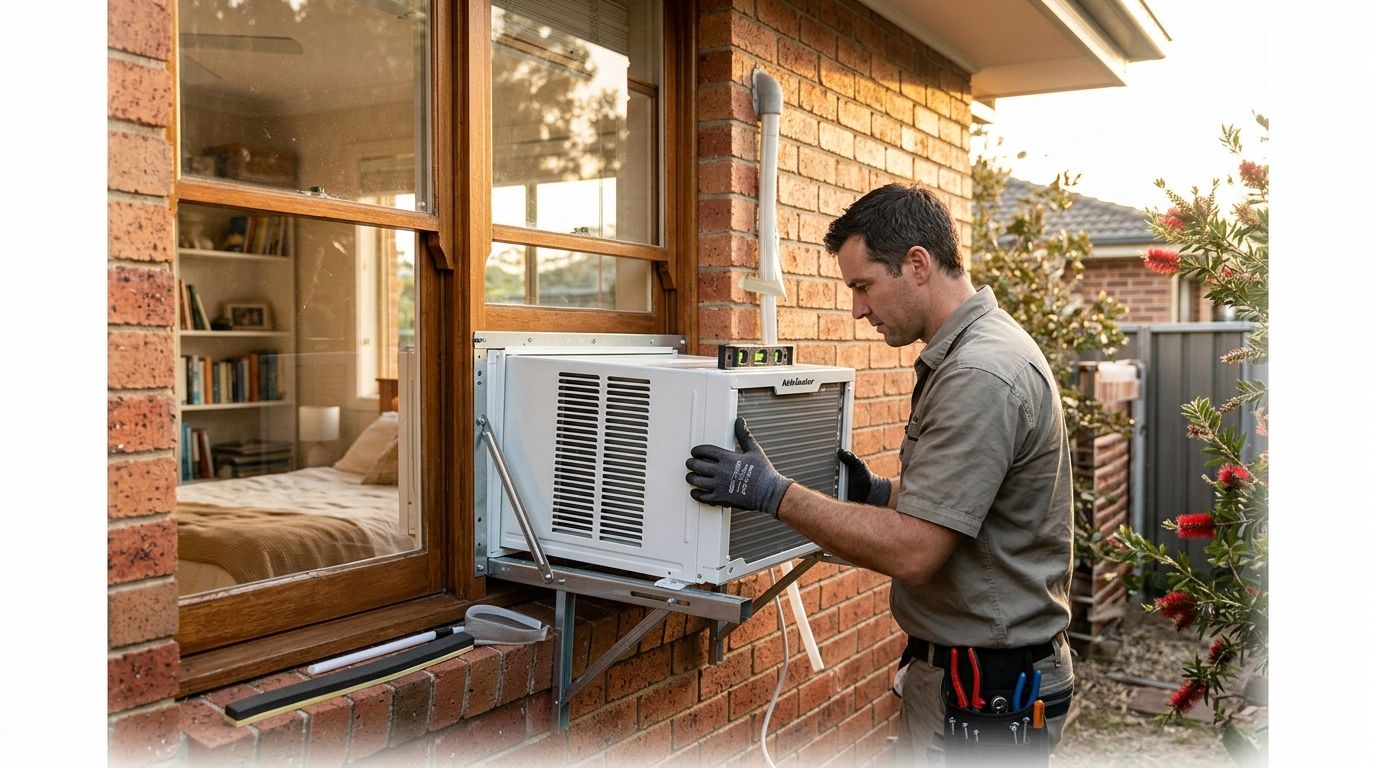
To install a window air conditioner, you open the lower sash, position the unit on the sill, lower the sash onto the top of the unit, secure the mounting brackets and seal any gaps with foam weatherstripping. The full process takes most people between 30 and 60 minutes. For any unit above 10kg, which covers the majority of window ACs on the market, you will need a second person to help with the lift.
The most common window air conditioner installation mistakes are poor levelling, unsealed gaps, overloaded circuits and choosing the wrong size unit for the room. Each of these problems is easy to avoid if you know what to look for, but they are also easy to miss in the rush to get the unit running on a hot day.
A window AC unit must tilt slightly toward the outside. If it sits level or tilts inward, condensate collects inside the unit and eventually drips into the room. Over time this causes water damage to walls, floors and the unit itself. A one to two degree outward tilt is all you need. Check it with a spirit level before you lower the sash.
Accordion panels alone do not create an airtight seal. Any gap between the unit, the panels and the window frame is a direct path for hot outside air to enter and cooled air to escape. Gaps also let in insects, which is a particular problem in Australian summers. Foam weatherstripping costs a few dollars and takes five minutes to apply. It is one of the highest-return steps in the whole installation.
Plugging a window AC into a circuit that is already running a fridge, microwave or other high-draw appliance is a common cause of nuisance tripping and, in worse cases, overheating. Check what else is on the circuit before you plug in. If the breaker trips repeatedly, the circuit is overloaded or the unit has a fault. Either way, stop using it until you have identified the cause.
A unit that is too small for the room will run constantly without ever reaching the set temperature, driving up your electricity bill without delivering comfort. A unit that is too large will cool the room too quickly, short-cycling before it has had time to remove humidity. The result is a room that feels cold but clammy. As a rough guide, allow around 150 watts of cooling capacity per square metre of floor area. A 15 square metre bedroom needs roughly 2.2 to 2.5kW. A 20 square metre living room needs closer to 3kW.
Room size is only one factor. Ceiling height, insulation, window orientation and the local climate all affect how hard the unit has to work. For a more thorough breakdown of how to match capacity to your space, read our guide on choosing the right size air conditioner for your room before you buy.
| Room Size | Recommended Capacity | Typical Use Case |
|---|---|---|
| Up to 15 m² | 1.5 to 2.5kW | Small bedroom, study |
| 15 to 25 m² | 2.5 to 3.5kW | Standard bedroom, small living room |
| 25 to 35 m² | 3.5 to 5.0kW | Large bedroom, open-plan kitchen |
| 35 m² and above | 5.0kW+ | Large living area, consider a split system instead |
A window air conditioner is cheaper upfront and you can install it yourself, but it is not always the best fit for every home or situation. For renters, small rooms or temporary cooling needs, a window unit makes practical sense. For homeowners who want quieter operation, better energy efficiency and a solution that does not block natural light, a split system air conditioning unit is worth the extra investment.
Here is an honest side-by-side comparison to help you decide:
| Factor | Window Unit | Split System |
|---|---|---|
| Upfront cost | $400 to $1,200 (supply only) | $895 to $2,500+ (supply only) |
| Installation | DIY, no licence required | Licensed technician required |
| Noise level | Louder, compressor is inside the room | Quieter, compressor sits outside |
| Energy efficiency | Lower star ratings, higher running costs | Higher star ratings, lower running costs |
| Natural light | Blocks part of the window opening | No window obstruction |
| Cooling capacity | Best suited to rooms under 25 m² | Available from 2.5kW to 9kW+ |
| Heating function | Limited or unavailable on most models | Reverse-cycle heating standard |
If you are leaning toward a split system, Frozone Air installs units from Daikin, Mitsubishi Electric, Fujitsu and Panasonic. For a small room up to around 20 m², the Daikin Cora 2.5kW is a solid entry-level option at approximately $895 supply only. The Mitsubishi Electric MSZ-AP25VGD 2.5kW is another strong choice in the same capacity range, priced at around $1,099 supply only, with a reputation for whisper-quiet operation. If your budget stretches a little further, the Fujitsu ASTG09KMCA 2.5kW sits in the mid-range and offers excellent efficiency ratings for Australian conditions.
Split systems do require a licensed technician to install, which adds to the total cost. If you want to understand what a split system installation actually involves, including what the technician does and how long it takes, that guide covers the full process.
Yes, in Australia you can install a window air conditioner yourself because it does not involve handling refrigerant. The process involves fitting the unit into a window opening, securing it with brackets and plugging it into a standard power outlet. However, if your unit requires a dedicated electrical circuit, a licensed electrician must carry out that work.
A window air conditioner unit itself typically costs between $400 and $1,200 in Australia depending on capacity and brand. Because installation is a DIY task, there is usually no labour cost, though you may need to pay a licensed electrician if a new circuit or outlet is required, which can add $150 to $400. Factor in the cost of weatherstripping and any mounting hardware not included with the unit.
The $5,000 rule is a rough guide for deciding whether to repair or replace an ageing air conditioner. Multiply the unit's age in years by the estimated repair cost. If the result exceeds $5,000, replacement is generally the more cost-effective choice. It is a useful starting point, but a qualified technician can give you a more accurate assessment based on the unit's condition and remaining lifespan.
The 3-minute rule means you should wait at least three minutes before restarting an air conditioner after switching it off. Restarting too quickly can cause the compressor to engage before the refrigerant pressure has equalised, which puts stress on the motor and can cause damage over time. Most modern units have a built-in delay to protect against this, but it is still a good habit to follow.
Window air conditioners are a legitimate, cost-effective option for renters, small rooms and anyone working with a tight budget. Get the sizing right, prepare your window properly and follow the installation steps carefully, and you will have a unit that performs reliably through the Australian summer.
That said, if you own your home and want something quieter, more energy-efficient and permanent, a professionally installed split system is worth every extra dollar. The running cost savings alone often close the gap within a few years.
If you are ready to explore a split system, Frozone Air installs Daikin, Mitsubishi Electric, Fujitsu and Panasonic units across Sydney and Melbourne. Request a free quote for air conditioning installation in Sydney or call the team directly on 1300 801 839 to talk through your options.