

How Does Hydronic Heating Work — And Is It Worth It for Australian Homes?
Wondering how does hydronic heating work? We explain the system, its pros and cons, running costs, and how it compares to reverse cycle for Australian homes.


Wondering how does hydronic heating work? We explain the system, its pros and cons, running costs, and how it compares to reverse cycle for Australian homes.
There is something genuinely appealing about stepping onto a warm floor on a cold winter morning, or sitting next to a radiator panel that heats a room without blowing a single puff of air. Hydronic heating delivers exactly that kind of warmth, and it has a loyal following among Australian homeowners who have experienced it. But how does hydronic heating work, and is it actually the right choice for an Australian home? This article walks through the core operating principles, the key components involved, the real running costs, and how hydronic heating stacks up against reverse cycle air conditioning, so you can make a genuinely informed decision.
Key takeaways
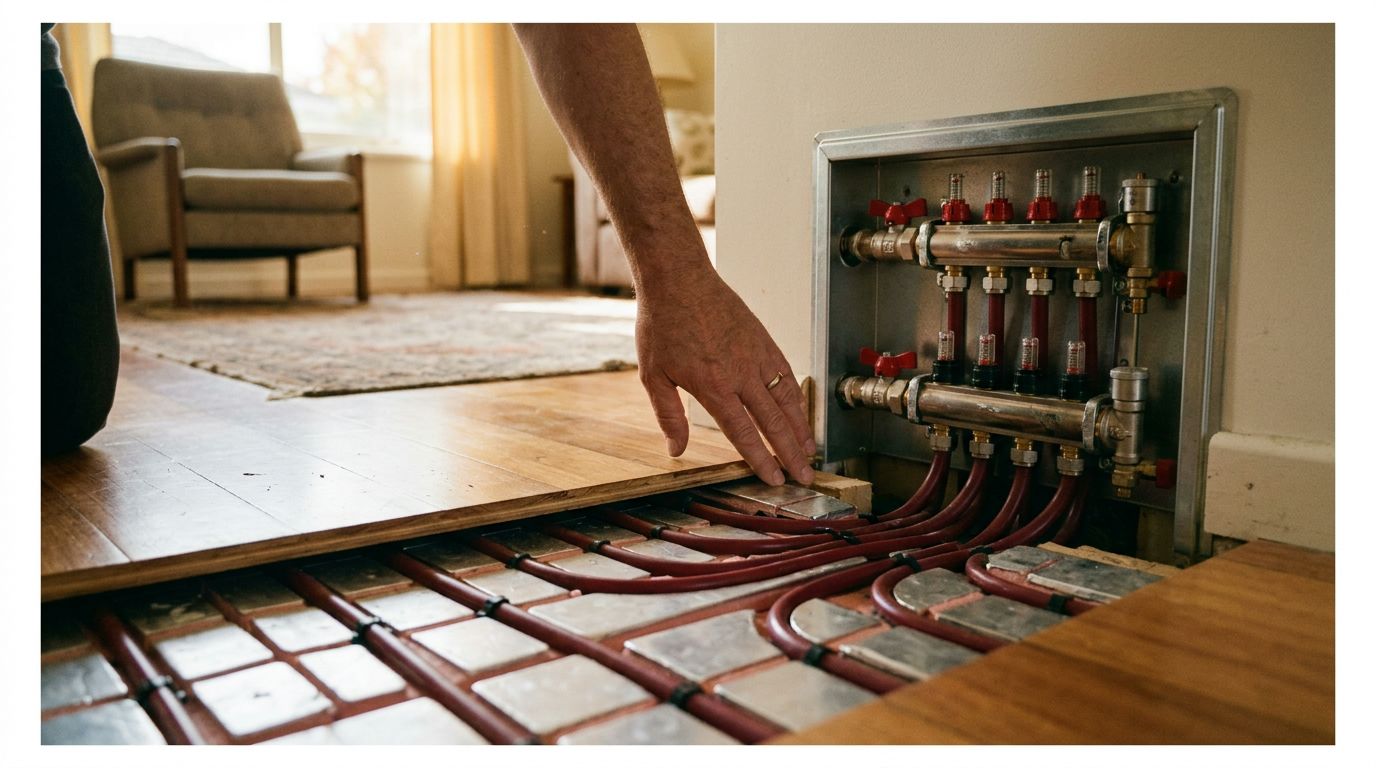
A hydronic heating system works by using hot water as the medium to carry heat around your home. A boiler heats water to a set temperature, a circulation pump pushes that hot water through a network of pipes, and heat emitters in each room release the warmth into the space. The cooled water then travels back to the boiler to be reheated, and the cycle continues. The whole process runs as a closed loop, so the same water circulates continuously rather than being consumed.
The defining characteristic of hydronic heating is that it delivers radiant warmth rather than forced air. Instead of a fan blowing heated air across a room, the heat emitters warm the surfaces and objects around them, which in turn warm the air. This is why a room heated by hydronic panels or underfloor loops tends to feel evenly warm rather than hot near the ceiling and cool near the floor. It also means no dust, allergens or dry air being circulated, which is a genuine advantage for households with asthma or allergies.
The trade-off is response time. A hydronic system takes longer to bring a cold room up to temperature than a reverse cycle split system, which can heat a room in minutes. Hydronic systems are designed to run for longer periods at lower temperatures, maintaining a steady background warmth rather than heating on demand. This suits homes that are occupied consistently throughout the day, but it is less efficient for households that only need heating for a few hours in the morning and evening.
Understanding the four main components helps clarify what you are actually paying for when you get a hydronic system installed.
Hydronic heating and reverse cycle air conditioning are the two most common whole-home heating solutions considered by Australian homeowners, but they sit at opposite ends of the cost, complexity and versatility spectrum. Hydronic systems deliver exceptional radiant comfort but cost $15,000 to $30,000 or more to install and provide no cooling. Reverse cycle split systems cost a fraction of that, heat and cool, and suit Australia's mixed climate far better in most cases.
| Factor | Hydronic Heating | Reverse Cycle Air Conditioning |
|---|---|---|
| Upfront Cost | Very high. Typically $15,000–$30,000+ for a whole home, depending on floor area and emitter type. | Low to moderate. A quality split system can be supplied and installed for $1,500–$3,500 per room. |
| Running Cost | Moderate to low with a gas boiler. Higher with electric resistance. Heat pump hydronic systems are more efficient but add to upfront cost. | Low to moderate. Modern inverter split systems achieve COPs of 3.0–5.0+, making them among the most efficient heating options available. |
| Installation Complexity | Very high. Requires a boiler, pipe network, emitters and controls. Retrofitting an existing home is disruptive and expensive. | Low to moderate. A standard split system installation takes half a day and requires minimal structural work. |
| Heating Comfort | Excellent. Radiant warmth is even, quiet and does not circulate dust or dry air. | Very good. Modern inverter systems maintain consistent temperatures, though some airflow is present. |
| Cooling Capability | None. Hydronic systems are heating-only. | Full cooling. Reverse cycle systems provide both heating and cooling from a single unit. |
| Suitability for Australian Climate | Best suited to cooler southern climates such as Victoria and Tasmania, where heating demand is high and cooling is less critical. | Suited to all Australian climate zones. Particularly practical in Sydney, Brisbane and other cities where summer cooling is essential. |
| Maintenance Requirements | Annual boiler service recommended. Pipe network and emitters are generally low-maintenance once installed. | Filter cleaning every 4–6 weeks. Annual professional service recommended. Refrigerant checks every few years. |
The upfront cost gap between these two systems is significant. A whole-home hydronic installation in a typical four-bedroom Melbourne home will commonly land between $20,000 and $30,000, and that figure climbs further if the home requires slab work or significant pipe routing. That same budget could cover a fully ducted reverse cycle system or multiple high-quality split systems throughout the home, with money to spare. The hydronic system also leaves you without any cooling solution, which means a separate outlay for air conditioning if you want it.
Hydronic heating does make genuine sense in specific situations. A new build in Victoria or Tasmania, where the slab can be prepared for underfloor loops before the concrete is poured, is the scenario where hydronic installation costs are most manageable and the comfort benefits are most appreciated. In those cooler climates, the heating season is long enough to justify the investment, and the absence of cooling is less of a practical problem. For homeowners in Sydney, Brisbane or Perth, where a 35-degree summer day is a regular occurrence, a heating-only system is simply not a complete solution.
For a broader look at all your options, see our guide to types of heaters compared for Australian homes.
Hydronic heating has real strengths, but it also has limitations that make it a poor fit for the majority of Australian homeowners. Understanding both sides honestly is the only way to decide whether it belongs in your home.
The honest assessment is that hydronic heating is rarely the most practical choice for most Australian homeowners. The comfort it delivers is real, but the cost, the lack of cooling and the complexity of retrofitting mean that reverse cycle air conditioning covers more ground for less money in the majority of situations. If you are still weighing up your options, our guide to best heating options for Australian homes covers the full picture.
A split system air conditioning can heat and cool your home year-round, installs in a single day and costs a fraction of what a hydronic system demands upfront. For most Australian homeowners, that combination is hard to argue with. A reverse cycle split system or ducted system is the practical answer to whole-home comfort in a climate where a 35-degree January afternoon is just as real as a frosty July morning.
Frozone Air installs and recommends leading brands including Daikin, Mitsubishi Electric, Panasonic and Fujitsu. At the entry level, the Daikin Cora 2.5kW (FTXM25YVMA) is a reliable, energy-efficient option for bedrooms and smaller living areas, retailing at around $900 to $1,100 supply only. The Mitsubishi Electric MSZ-AP Series 2.5kW (MSZ-AP25VGD) is a consistently popular mid-range choice, priced at around $1,000 to $1,200 supply only and well regarded for its quiet operation and heating performance in cooler temperatures. For larger rooms, the Daikin Alira X 3.5kW (FTXM35YVMA) steps up the capacity and the feature set, with supply-only pricing around $1,300 to $1,600.
Even with professional installation added to those figures, you are looking at a fraction of the $15,000 to $30,000 that a whole-home hydronic setup typically costs. And unlike hydronic, every one of those units cools your home through summer as well as heating it through winter.
For homes that need whole-home coverage, a ducted reverse cycle system is worth considering alongside individual split systems. Both options are far less disruptive to install than hydronic and both can be up and running in days rather than weeks.
Our team handles air conditioning installation in Sydney for all major brands. Get in touch for a free quote, or browse our full range of split systems to find the right unit for your home.
Hydronic heating is worth it for a narrow set of Australian homeowners. Primarily those building new homes in Victoria or Tasmania, where the heating season is long and underfloor loops can be installed before the slab is poured. For most Australians, the $15,000 to $30,000 upfront cost, combined with the complete absence of cooling, makes reverse cycle air conditioning a more practical and cost-effective choice.
Running costs depend heavily on the heat source. A gas-boosted hydronic system typically costs less to run per hour than electric resistance heating, but gas prices vary significantly by state and have risen sharply in recent years. Heat-pump-driven hydronic systems offer better efficiency but add to the upfront cost. For most households, a modern inverter reverse cycle split system will deliver lower running costs than a gas hydronic system.
Hydronic heating can physically work in Sydney, but it is rarely the right choice there. Sydney's mild winters mean the heating season is short, which makes it difficult to recoup the high installation cost through running cost savings. More critically, Sydney summers regularly exceed 35 degrees and a hydronic system provides no cooling at all, meaning you would still need a separate air conditioning solution.
Underfloor heating is one type of hydronic heating, not a separate system. Hydronic heating is the broader category, referring to any system that uses hot water circulated through pipes to deliver heat. Underfloor hydronic heating specifically routes those pipes beneath the floor surface to warm the floor from below. Other hydronic emitter types include wall-mounted panel radiators, towel rails and trench convectors.
Hydronic heating is a genuinely impressive system for the right home. It delivers quiet, even, allergen-free warmth that is hard to match. But for most Australian homeowners, a reverse cycle split system offers better value, year-round versatility and a far simpler path to installation. Unless you are building new in a cold southern climate or have specific health reasons to avoid forced air, hydronic heating is a premium solution to a problem that a quality split system can solve for a fraction of the cost.
If you are still weighing up your options, the team at Frozone Air is happy to help. We supply and install leading brands across Australia and can recommend the right system for your home, budget and climate zone. Request a free quote online or call us on 1300 801 839 to speak with one of our specialists.