

How Does Air Conditioning Work? A Simple Explanation for Homeowners
Wondering how does air conditioning work? We explain the refrigeration cycle, key components, and how reverse cycle systems heat and cool your home.


Wondering how does air conditioning work? We explain the refrigeration cycle, key components, and how reverse cycle systems heat and cool your home.

Air conditioning works by moving heat from inside your home to the outside, not by generating cold air from scratch. A chemical called refrigerant circulates through the system in a continuous loop, absorbing heat from your indoor air and releasing it outdoors. The result is that your room feels cooler, even though no cold air was ever actually created.
The process that makes this possible is called the refrigeration cycle, and it relies on four main components: the evaporator coil, the compressor, the condenser coil and the expansion valve. Most modern systems are reverse cycle units, which means they can run the process in reverse to heat your home in winter as well. The sections below break down exactly how each part of the cycle works.
Key takeaways
The refrigeration cycle is a continuous four-stage loop that transfers heat from one place to another using a circulating refrigerant. Your air conditioner does not consume or destroy heat. It simply picks it up from inside your home and deposits it outside. Understanding this loop explains why your outdoor unit feels warm to the touch on a hot day, and why the same system can heat your home in winter.
The four stages work like this:
A useful analogy is your kitchen fridge. It uses exactly the same refrigeration cycle to keep food cold. It just moves heat from inside the fridge cabinet to the coils at the back. Your split system does the same thing on a larger scale, with your whole room as the 'cabinet'.
Refrigerant is the chemical compound that makes the entire heat-transfer cycle possible. It has a very low boiling point, which means it can evaporate and absorb heat at temperatures well below what water or air could manage. Without refrigerant, there is no cycle and no cooling.
Most modern split systems use either R32 or R410A refrigerant. R32 has become the more common choice in newer models because it has a lower global warming potential than R410A, making it a more environmentally responsible option. Both are safe and effective under normal operating conditions.
One thing worth knowing: refrigerant operates in a sealed, closed loop. Under normal use it is never consumed or depleted, so the level should never drop. If a technician tells you your system is 'low on gas', that is not routine maintenance. It means there is a leak somewhere in the system. Handling refrigerant requires an ARC (Australian Refrigeration Council) licence, so a leak is not something you can fix yourself. You will need a licensed technician to locate the leak, repair it and recharge the system. For a deeper look at how refrigerant behaves and what to do if your system loses charge, see our guide to air conditioner refrigerant.
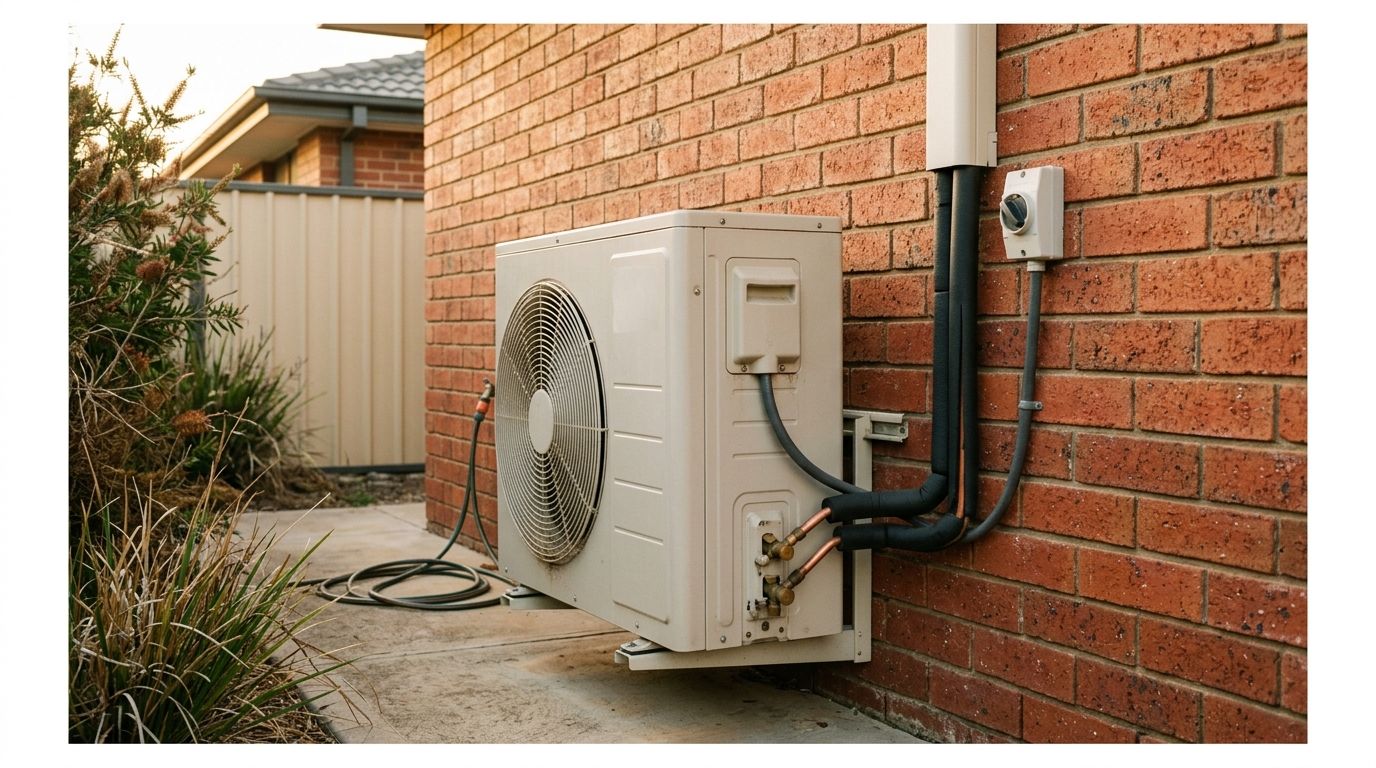
A split system air conditioning unit has four main physical components that work together to run the refrigeration cycle described above. Each one has a specific job, and if any of them fails, the whole system stops working. Here is what each component does in plain terms.
A split system delivers conditioned air directly into a single room through the wall-mounted indoor unit. A ducted air conditioning system replaces that indoor unit with a central air handler, typically installed in the roof cavity or under the floor, which pushes conditioned air through a network of ducts and ceiling vents to condition multiple rooms or an entire home. The refrigeration cycle running underneath both setups is identical. The only difference is how the conditioned air gets distributed.
Both system types have their place. A split system is well suited to apartments, single rooms or smaller homes where you want to condition one or two zones. A ducted system suits larger homes where whole-home comfort and a cleaner aesthetic are the priority. Frozone Air installs both across Sydney and Melbourne, so if you are unsure which suits your home, our team can walk you through the options.
Most modern split systems sold in Australia are reverse cycle units, meaning the same system that cools your home in summer can heat it in winter. Reverse cycle heating works by running the refrigeration cycle in the opposite direction, so the outdoor unit absorbs heat from the outside air and the indoor unit releases that heat into your room. This is possible even on cold days because there is usable heat energy in outdoor air down to around minus 15 Celsius.
The key to reversing the cycle is a component called the reversing valve. In cooling mode, refrigerant flows in one direction around the loop. Switching to heating mode flips the valve, which reverses the refrigerant's direction of travel. The outdoor unit now acts as the evaporator, pulling heat from the outside air, and the indoor unit acts as the condenser, releasing that heat indoors.
This is why reverse cycle heating is so much more efficient than a standard electric bar heater or resistive element. A resistive heater converts one unit of electricity into one unit of heat. A reverse cycle system does not generate heat at all. It moves existing heat from outside to inside. The result is a coefficient of performance (COP) of three to five, meaning you get three to five units of heat energy for every single unit of electricity you consume. At typical Australian electricity prices, that is a significant saving over winter.
Two of the most popular reverse cycle split systems Frozone Air installs are the Daikin Cora (for example, the FTXM25Y 2.5kW) and the Mitsubishi Electric MSZ-AP series (for example, the MSZ-AP25VGD 2.5kW). Both are well-regarded for their heating performance in Australian conditions, with strong COP ratings and reliable operation even on cold winter nights in Melbourne or the Sydney basin.
For a closer look at how the reversing valve works and what to expect from reverse cycle heating across different climate zones, see our article on how reverse cycle aircon works.
Understanding how the refrigeration cycle works has three direct, practical implications for how you look after your air conditioner. Regular servicing keeps the cycle running efficiently, refrigerant leaks require a licensed technician by law, and choosing an inverter model will save you money on running costs every single day the system operates.
The refrigeration cycle depends on clean, unobstructed heat transfer at both the evaporator and condenser coils. When dust and grime build up on those coils, they act as insulation, making it harder for the refrigerant to absorb or release heat. The compressor then has to work harder and run longer to achieve the same result, which pushes up your electricity bill and shortens the life of the unit.
Dirty filters restrict airflow across the evaporator coil, which compounds the problem. Blocked drain lines can cause water to back up into the indoor unit. A proper annual service covers all of this: coil cleaning, filter cleaning or replacement, drain line flushing and a refrigerant pressure check. It is the single most effective thing you can do to keep running costs down and avoid an expensive breakdown mid-summer.
Refrigerant is a controlled substance under Australian law. Under the Ozone Protection and Synthetic Greenhouse Gas Management Act, only a technician holding an ARC (Australian Refrigeration Council) licence is legally permitted to handle, recover or recharge refrigerant. This applies to both R410A and R32 systems.
If your system is not cooling properly and a technician suspects low refrigerant, do not attempt to source or add refrigerant yourself. The real issue is always a leak somewhere in the sealed loop, and adding gas without finding and fixing the leak is both illegal and pointless. A licensed technician will pressure-test the system, locate the leak, repair it and then recharge to the correct specification.
A conventional fixed-speed compressor has two states: fully on or fully off. It blasts at full power until the room hits the target temperature, then cuts out completely, then blasts again when the temperature drifts. This on-off cycling is inefficient and creates noticeable temperature swings in the room.
An inverter compressor varies its speed continuously to match the actual load. Once the room is close to the target temperature, it slows right down and trickles just enough capacity to hold it there. This uses significantly less electricity and keeps the temperature far more stable. For a detailed breakdown of how inverter technology works and how much it can save, see our article on what is an inverter air conditioner.
Two strong examples of inverter models Frozone Air installs are the Fujitsu ASTG series (for example, the ASTG09KMCA 2.5kW) and the Panasonic CS-Z series. Both use variable-speed inverter compressors, carry strong energy star ratings and are well suited to Australian conditions across a range of climate zones.
No. An air conditioner does not generate cold air. It removes heat from the air inside your room and transfers that heat to the outdoors using a circulating refrigerant. The air feels cooler because its heat has been extracted, not because cold air has been added to it.
The outdoor unit blows hot air because it is releasing the heat that was absorbed from inside your home. The condenser coil in the outdoor unit receives hot, high-pressure refrigerant gas and uses a fan to push outside air across the coil, which causes the refrigerant to release its heat and condense back into a liquid. This is the system working exactly as it should.
No. Handling refrigerant in Australia requires an ARC licence, and it is illegal for unlicensed individuals to purchase or handle refrigerant. Beyond the legal issue, a drop in refrigerant always indicates a leak in the sealed system. Adding gas without repairing the leak will not fix the problem and the refrigerant will simply escape again. You need a licensed technician to find the leak, repair it and recharge the system correctly.
A reverse cycle air conditioner heats a room by running the refrigeration cycle in reverse. Instead of absorbing heat from indoor air and releasing it outside, the system absorbs heat from the outdoor air and releases it inside. This works even on cold days because there is usable heat energy in outdoor air down to around minus 15 Celsius, making reverse cycle heating far more efficient than a standard electric heater.
Air conditioners work by moving heat, not manufacturing cold air. Once you understand that simple principle, the rest follows naturally: why regular servicing matters, why refrigerant leaks need a licensed technician, and why an inverter system will cost you less to run year after year. That knowledge puts you in a much better position to make smart decisions about your home comfort.
If you are ready to act on any of that, Frozone Air's licensed technicians work across Sydney and Melbourne. Whether you need a new system installed, an existing unit serviced or a problem diagnosed, we can help.
No pressure, no jargon. Just practical advice from people who install and service air conditioners every day.