

What Is an Inverter Air Conditioner and How Does It Work?
Wondering what an inverter air conditioner is and how it works? We explain the technology, benefits, and whether it's worth it for Australian homes.


Wondering what an inverter air conditioner is and how it works? We explain the technology, benefits, and whether it's worth it for Australian homes.
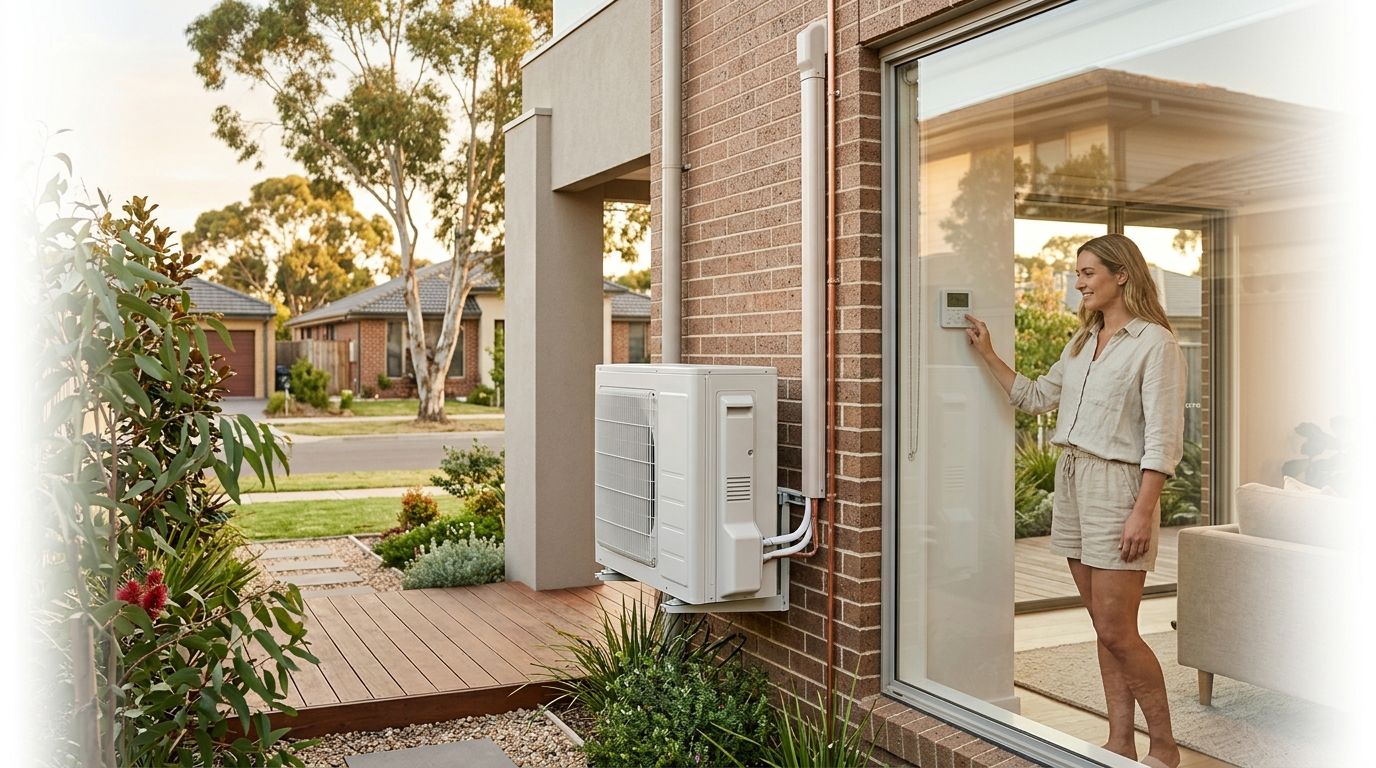
An inverter air conditioner is a system whose compressor runs at variable speeds, continuously adjusting its output to match the cooling or heating demand in your room. Unlike a fixed-speed unit that simply switches fully on or fully off, an inverter unit modulates its power, which means it holds your target temperature more accurately and uses less electricity doing it. For anyone researching types of air conditioning systems, understanding the inverter versus non-inverter distinction is the single most useful place to start.
Fixed-speed systems blast at full capacity until the room hits the set temperature, then cut out completely. The cycle repeats every few minutes, causing noticeable temperature swings and a spike in power draw every time the compressor restarts. Inverter systems avoid all of that by never fully switching off.
Key takeaways
An inverter air conditioner works by using an electronic inverter circuit to convert incoming AC power to DC, then back to AC at a variable frequency. Changing that output frequency changes the speed of the compressor motor, which in turn controls how much refrigerant is pumped through the system at any given moment. The result is a unit that can ramp up hard when the room is hot and then ease back to a gentle idle once the target temperature is reached.
Here is how the full cooling cycle plays out from the moment you press the button:
This continuous feedback loop is what separates inverter technology from older fixed-speed designs. The system is always listening and always adjusting, rather than lurching between full power and complete shutdown.
The compressor is the heart of any air conditioner, and the difference between variable-speed and fixed-speed compressors explains most of the performance gap between inverter and non-inverter units.
| Feature | Fixed-Speed Compressor | Variable-Speed (Inverter) Compressor |
|---|---|---|
| Operating range | 100% on or 0% off | Roughly 15% to 100% capacity |
| Temperature control | Cycles cause noticeable swings of 1 to 2°C | Holds within 0.5°C of the set point |
| Energy use at restart | High current surge every cycle | No restart surges, compressor stays running |
| Noise | Audible click and hum each time it kicks in | Quieter, more consistent background hum |
| Wear and tear | Stop-start cycling stresses components | Continuous low-load operation reduces wear |
| Running cost | Higher over time due to inefficiency | Typically 30 to 50% lower energy bills |
Fixed-speed units are cheaper upfront and still available, but the energy savings from an inverter compressor generally recover the price difference within a few years of regular use. For most Australian households running a system through both summer and winter, the inverter option is the more cost-effective choice over the life of the unit.

Inverter air conditioners offer Australian households five clear advantages over fixed-speed units: lower electricity bills, more consistent temperatures, quieter operation, faster initial cooling and a longer working lifespan. These benefits are especially relevant in Australia, where long cooling seasons, high electricity prices and increasingly hot summers make running costs a genuine concern for most families.
The biggest draw of inverter technology is the reduction in electricity use. Because the compressor never fully switches off and avoids repeated high-current restarts, inverter units typically use 30 to 50% less electricity than a comparable fixed-speed model running the same hours. With Australian residential electricity averaging well above 30 cents per kWh in most states, those savings add up quickly across a full summer. If you want to work out exactly what your system will cost to run, our guide on how much power an air conditioner uses walks through the calculation step by step.
Australia's energy star rating system reflects this directly. Inverter split systems routinely achieve six or more stars on the cooling and heating scales, while fixed-speed units rarely crack four. The more stars, the lower the annual running cost estimate printed on the label.
Fixed-speed systems overshoot and undershoot your set temperature because they can only run at full blast or not at all. An inverter unit holds the room within about 0.5°C of your target, which means no more waking up sweating at 2am because the system cut out, or shivering when it kicks back in. For bedrooms and living areas used for long stretches, that consistency makes a noticeable difference to comfort.
At steady-state idle, an inverter compressor runs at a fraction of its maximum speed. The outdoor unit hums along quietly rather than cycling on with a loud clunk every few minutes. Many modern inverter split systems from Daikin, Mitsubishi Electric and Fujitsu are rated below 20 decibels on the indoor unit at low fan speed, which is quieter than a library.
Inverter units are not slow starters. On a hot afternoon, the compressor ramps up to maximum capacity immediately, pulling the room temperature down as fast as the system's kilowatt rating allows. Once the target is reached, it dials back rather than switching off. You get the speed of a full-power system without the inefficiency of one that can only run at full power.
Repeated stop-start cycling puts mechanical stress on compressor components, particularly the motor windings and refrigerant valves. Because an inverter compressor stays running at low load rather than hammering through thousands of on/off cycles each year, the internal components experience far less wear. This translates to fewer breakdowns and a longer service life, typically 15 to 20 years with proper maintenance versus 10 to 12 years for a fixed-speed unit used in the same conditions.
Virtually all modern split systems sold in Australia today use inverter technology as standard. Daikin, Mitsubishi Electric and Fujitsu have built inverter compressors into their entire residential ranges, so if you are buying a new system from a reputable brand, you are almost certainly getting an inverter unit by default.
For most Australian households, an inverter air conditioner is the better choice on almost every measure except upfront purchase price. The table below lays out the key differences so you can weigh them against your own situation.
| Feature | Inverter AC | Non-Inverter AC |
|---|---|---|
| Purchase price | Higher upfront cost | Lower upfront cost |
| Running cost | 30 to 50% lower electricity use | Higher, due to constant full-power cycling |
| Temperature consistency | Holds within ~0.5°C of set point | Swings of 1 to 2°C between cycles |
| Noise level | Quieter at steady-state idle | Audible click and hum each time it restarts |
| Startup speed | Fast, ramps to full capacity immediately | Fast, but runs at full power the whole time |
| Lifespan | Typically 15 to 20 years | Typically 10 to 12 years |
| Availability in Australia | Standard across all major brands | Increasingly rare in residential market |
Non-inverter units are cheaper to buy, but that price advantage erodes quickly once you factor in higher electricity bills and a shorter service life. For a household running their system regularly through both summer and winter, an inverter unit typically recovers the price difference within two to four years through energy savings alone. Non-inverter models are now increasingly rare in the Australian residential market, with most major brands having phased them out of their standard split system ranges entirely.
If you are ready to browse current inverter models, our split system air conditioning range covers options from Daikin, Mitsubishi Electric, Fujitsu and more, with systems to suit rooms of every size.
If you are shopping for an inverter split system and want a shortcut through the noise, here are three models we regularly install and would confidently recommend to friends and family. Each suits a different room size and budget, so there is a practical option regardless of your situation.
The Daikin Cora 2.5kW is our go-to recommendation for anyone cooling or heating a small bedroom, study or single-person apartment. It carries a high energy star rating, runs whisper-quiet at low fan speeds, and Daikin's build quality means it will still be running reliably a decade from now. Supply-only pricing sits at around $900 to $1,100, making it one of the most accessible entry points into a premium inverter system.
For a medium-sized lounge, open-plan kitchen or master bedroom, the Mitsubishi Electric MSZ-AP 3.5kW is a standout mid-range option. Its Hyper Heating capability means it maintains strong heating output even when outdoor temperatures drop well below zero, which is genuinely useful for Melbourne winters. Supply-only pricing is typically $1,100 to $1,400, and the build quality justifies every dollar of that premium.
The Fujitsu ASTG12KMTC is a competitively priced inverter split system that punches above its weight. Its compact indoor unit profile makes it a good fit for rooms where wall space is tight, and it handles both bedrooms and smaller open-plan areas comfortably. Supply-only pricing runs from around $950 to $1,200, making it a strong choice if you want reliable inverter performance without stretching the budget.
Whichever model you choose, sizing matters just as much as the technology inside it. A correctly sized inverter unit will always outperform an oversized or undersized one, regardless of how many stars it carries. Too large and the system short-cycles before it can dehumidify properly. Too small and it runs flat out without ever reaching your set temperature. Getting the kilowatt rating right for your room is the single most important decision in the whole process.
For readers who want to go deeper on efficiency ratings before committing, our guide to the most energy-efficient air conditioners in Australia compares star ratings, running costs and the models worth prioritising in 2026.
Inverter technology is now the standard in Australian homes for good reason. It uses significantly less electricity than fixed-speed alternatives, holds your target temperature with far greater precision, and is built to last well over a decade with proper servicing. The upfront cost is higher, but the long-term savings on energy bills and repairs make it the smarter investment for virtually every household.
At Frozone Air, our teams across Sydney and Melbourne install inverter split systems every day. We know which models suit which rooms, and we will make sure your system is sized correctly from the start.
Get a free quote for supply and installation by filling out our online form, or call us on 1300 801 839 to talk through your options with someone who actually knows their stuff.
Yes, for most Australian households an inverter air conditioner is worth the higher upfront price. The 30 to 50% reduction in electricity use compared to a fixed-speed unit means the price difference is typically recovered within two to four years of regular use. Over a 15 to 20 year lifespan, the total savings are substantial.
Actual consumption depends on the kilowatt rating of the unit, how often it runs and the climate in your area. A 2.5kW inverter split system like the Daikin Cora FTXM25YVMA might draw as little as 0.5 to 0.7kW at steady-state idle once the room is up to temperature. Our guide on how much power an air conditioner uses walks through the full calculation with real numbers.
Yes. Almost all inverter split systems sold in Australia are reverse-cycle units, meaning they can both cool in summer and heat in winter using the same refrigerant circuit. Models like the Mitsubishi Electric MSZ-AP 3.5kW include Hyper Heating technology that maintains strong output even in very cold conditions, making them a practical year-round solution.
A well-maintained inverter split system typically lasts 15 to 20 years. Because the compressor runs continuously at low load rather than cycling on and off thousands of times a year, internal components experience far less mechanical stress than in a fixed-speed unit. Annual servicing and regular filter cleaning are the two biggest factors in reaching that upper end of the lifespan.