

Air Conditioner Refrigerant: What It Is, How It Works and When It Needs Replacing
Learn what refrigerant air conditioner systems use, how the cooling cycle works, which gas your unit needs, and the signs it may be leaking or low.


Learn what refrigerant air conditioner systems use, how the cooling cycle works, which gas your unit needs, and the signs it may be leaking or low.
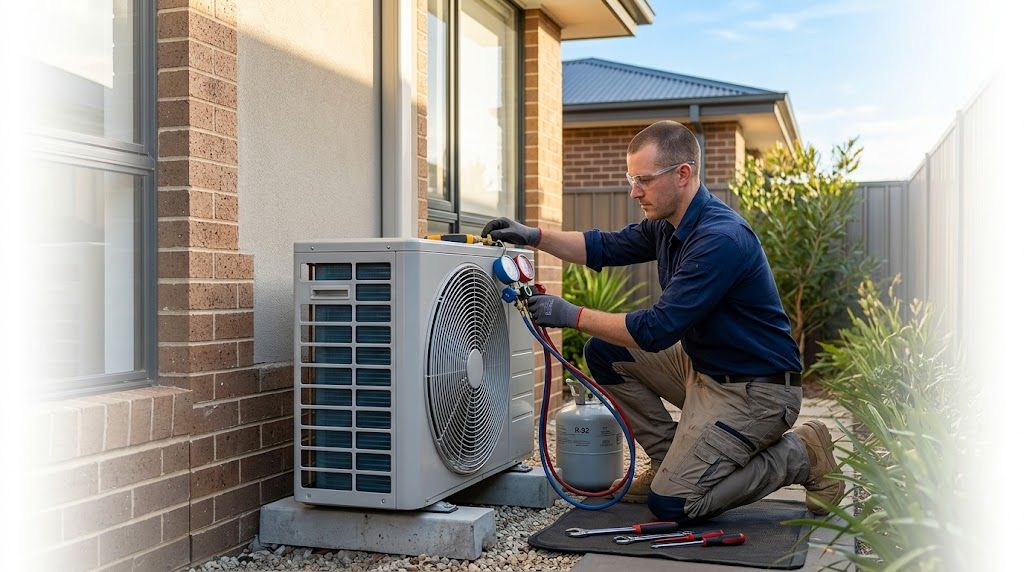
Refrigerant is the chemical compound that makes your air conditioner actually work. In a refrigerant air conditioner system, this substance circulates continuously through a closed loop of coils and components, absorbing heat from the air inside your home and releasing it outside. Without the correct refrigerant charge, your system simply cannot transfer heat effectively, leaving you with an indoor unit that blows air but barely cools or heats the room.
Think of refrigerant less like a fuel and more like a working fluid. It does not get consumed during normal operation. The same charge that was installed on day one should still be doing its job years later, provided the system has no leaks.
This article covers how the refrigerant cycle works, the different types of refrigerant you will find in Australian homes, how to spot signs of a problem, and when it is time to call a licensed technician.
Key takeaways
The refrigeration cycle is the process your split system uses to move heat from one place to another. Refrigerant is the medium that carries that heat, changing between liquid and gas states as it travels around the system. The whole cycle happens continuously while your unit is running, and it repeats hundreds of times per hour.
Here are the four key stages of the cycle:
On a reverse-cycle system, this process can run in the opposite direction during winter. The refrigerant absorbs heat from the outdoor air (even on cold days, there is usable heat energy outside) and releases it indoors, which is how your split system heats your home efficiently.
A properly sealed refrigerant system is a closed loop. The refrigerant is not burned, evaporated away or consumed in any other way during normal operation. If the refrigerant level in your system drops, there is only one explanation: there is a leak somewhere in the system.
Topping up the refrigerant without locating and repairing the leak is a short-term fix that will cost you money twice. The new charge will simply escape through the same leak, and you will be back to square one within months. Beyond the wasted expense, it is also a legal issue. Under Australian regulations, only technicians holding an ARCtick licence are permitted to handle refrigerants. An unlicensed person purchasing or handling refrigerant is breaking the law, and any reputable service company will always find and fix the leak before recharging the system.
If your system is low on refrigerant, the right call is a licensed technician who will pressure-test the system, find the source of the leak, repair it, and then recharge to the manufacturer's specified level.

Australian homeowners are most likely to encounter three refrigerant types: R22, R410A and R32. Each generation has a lower environmental impact than the last, and knowing which one your system uses matters before any service work is carried out. If you are unsure, an air conditioning service Sydney technician can identify the refrigerant type from the system's data plate before touching the refrigerant circuit.
| Refrigerant Type | Common Name | GWP (Global Warming Potential) | Found In | Phase-Out Status |
|---|---|---|---|---|
| R22 | Freon | ~1,810 | Systems installed before approximately 2010 | Banned from import and manufacture in Australia since 2020. No longer available for top-ups. |
| R410A | Puron | ~2,088 | Systems installed roughly between 2010 and 2020 | Still in widespread use but being phased down under the Kigali Amendment to the Montreal Protocol. |
| R32 | Difluoromethane | ~675 | Most new Daikin, Mitsubishi Electric, Fujitsu and Panasonic split systems sold today | Current standard for new residential systems. No phase-out planned in the near term. |
R32 is now the dominant refrigerant in new residential split systems across Australia. Its GWP is roughly two-thirds lower than R410A, which is why all the major brands have moved to it for their current lineups. If you bought a new split system in the last few years, it almost certainly runs on R32.
Homeowners with older R22 systems need to be aware of a practical problem: R22 refrigerant is no longer available in Australia for top-ups. If an R22 system develops a leak, there is no legal way to recharge it. A system replacement is the only practical path forward, and given that R22 systems are typically 15 or more years old at this point, that is usually the right call on performance and efficiency grounds anyway.
A refrigerant leak produces a recognisable set of symptoms, though most of them can also be caused by other faults such as dirty filters or blocked coils. The five signs below are the most common indicators that your system may have a refrigerant problem, but a licensed technician should always confirm the diagnosis before any refrigerant work is done.
These symptoms overlap significantly with other common faults. A clogged filter can cause ice build-up. A dirty condenser coil can cause warm air output and longer run times. This is why it is worth reading our guide to aircon regas: what it is, when you need it and how much it costs before drawing conclusions, and why a proper diagnosis from a licensed technician is essential. Topping up the refrigerant without finding the leak is a waste of money and, under Australian regulations, any technician who does so without repairing the source first is not doing the job properly.
If you are seeing one or more of these signs, book a technician to pressure-test the system and confirm the cause. Our team handles air conditioner repairs Sydney homeowners can rely on, including leak detection, repair and recharge to manufacturer specifications.
The right response to a refrigerant issue depends on three factors: the age of your system, the type of refrigerant it uses and the size of the leak. A small leak on a newer unit is a straightforward repair job. An older system with a significant leak is a different calculation entirely, and an R22 system of any age has only one practical path forward.
If your system is relatively new and a technician finds a minor leak, the cost-effective approach is to locate and repair the leak, then recharge the system to the manufacturer's specified level. A quality split system should have a service life of 15 or more years, so a repair at this stage makes good financial sense provided the rest of the system is in sound condition.
Expect to pay somewhere in the range of $150 to $350 for leak detection and repair, plus the cost of the refrigerant recharge on top. That is a reasonable outlay for a system that still has years of reliable service ahead of it.
For systems over 10 years old running on R410A, the maths shifts. A major leak may require replacing a coil or other components, and the repair bill can climb quickly. At that point, you need to weigh the repair cost against the cost of a full replacement with a modern R32 unit.
A new 2.5kW R32 split system, supplied and installed, typically costs between $1,400 and $1,800 depending on the brand and installation complexity. That is not a trivial sum, but a modern unit will run significantly more efficiently than a 10-year-old system, which can meaningfully reduce your electricity bills over time. For a direct comparison of efficiency ratings across current models, the guide to most energy-efficient air conditioners in Australia is worth reading before you make a decision.
If your system runs on R22, replacement is the only practical option. R22 refrigerant has been banned from import and manufacture in Australia since 2020, which means there is no legal way to recharge an R22 system that has lost its charge. These systems are typically 15 or more years old at this point, so the efficiency gap compared to a modern unit is substantial.
Current R32 split systems from Daikin, Mitsubishi Electric and Fujitsu are significantly more efficient than anything running R22. The Daikin Cora (for example, the FTXM25Y 2.5kW) is a popular replacement choice, with supply and install pricing typically around $1,400 to $1,700. The Mitsubishi Electric MSZ-AP25VGD 2.5kW sits in a similar bracket at around $1,500 to $1,800 installed, and the Fujitsu ASTG09KMCA 2.5kW comes in at roughly $1,400 to $1,700 supply and install. All three run on R32 and carry strong energy star ratings that older R22 units simply cannot match.
| Situation | Recommended Action | Approximate Cost |
|---|---|---|
| Small leak, system under 8 years old | Repair leak and regas | $150 to $500 total |
| Significant leak, R410A system over 10 years old | Compare repair cost vs. replacement. Replacement often wins. | Repair: $400 to $900+. Replacement: $1,400 to $1,800 installed |
| R22 system, any age | Replace with a modern R32 unit | $1,400 to $1,800 installed for a 2.5kW split system |
A properly sealed air conditioner should never need regassing. Refrigerant is not consumed during normal operation, so if the level has dropped, there is a leak that needs to be found and repaired first. If your system has been regassed more than once in a few years, the underlying leak has not been properly fixed.
Running a system with low refrigerant puts unnecessary strain on the compressor, which is the most expensive component in the unit. The compressor is designed to handle refrigerant gas, not liquid, and low charge conditions can cause it to overheat or fail prematurely. Switch the system off and book a technician rather than continuing to run it in this state.
No. Under Australian law, only technicians holding an ARCtick licence issued by the Australian Refrigeration Council are permitted to purchase and handle refrigerants. Unlicensed handling of refrigerant is a legal offence, and no reputable supplier will sell refrigerant to an unlicensed individual. Always use a licensed air conditioning technician for any refrigerant work.
The refrigerant type is printed on the data plate, which is usually located on the side or back of the outdoor unit. Systems installed before around 2010 typically use R22, those installed between 2010 and 2020 generally use R410A, and most systems sold from around 2018 onwards use R32. If you cannot locate the data plate, a licensed technician can identify the refrigerant type before carrying out any service work.
Refrigerant is the lifeblood of any air conditioner. It should never need topping up under normal conditions, and if it does, a leak is the reason. Older systems running on R22 cannot be legally recharged in Australia and are overdue for replacement. For any refrigerant work, only an ARCtick-licensed technician can legally handle the job.
If your system is blowing warm air, icing up or running longer than it used to, do not put it off. The longer a leak goes unaddressed, the harder your compressor works and the closer it gets to an expensive failure.
Frozone Air services customers across Sydney and Melbourne. You can book a refrigerant check, leak repair or full system replacement online, or call us directly on 1300 801 839. Sydney customers can book an air conditioning service Sydney technicians trust through our online booking form. We will sort out the diagnosis and give you a straight answer on whether a repair or replacement makes more sense for your situation.