

How to Dispose of an Old Air Conditioner in Australia: Old Aircon Removal Guide
Need old aircon removal in Australia? Learn how to legally dispose of your AC, what it costs, recycling options, and when to replace instead of repair.


Need old aircon removal in Australia? Learn how to legally dispose of your AC, what it costs, recycling options, and when to replace instead of repair.
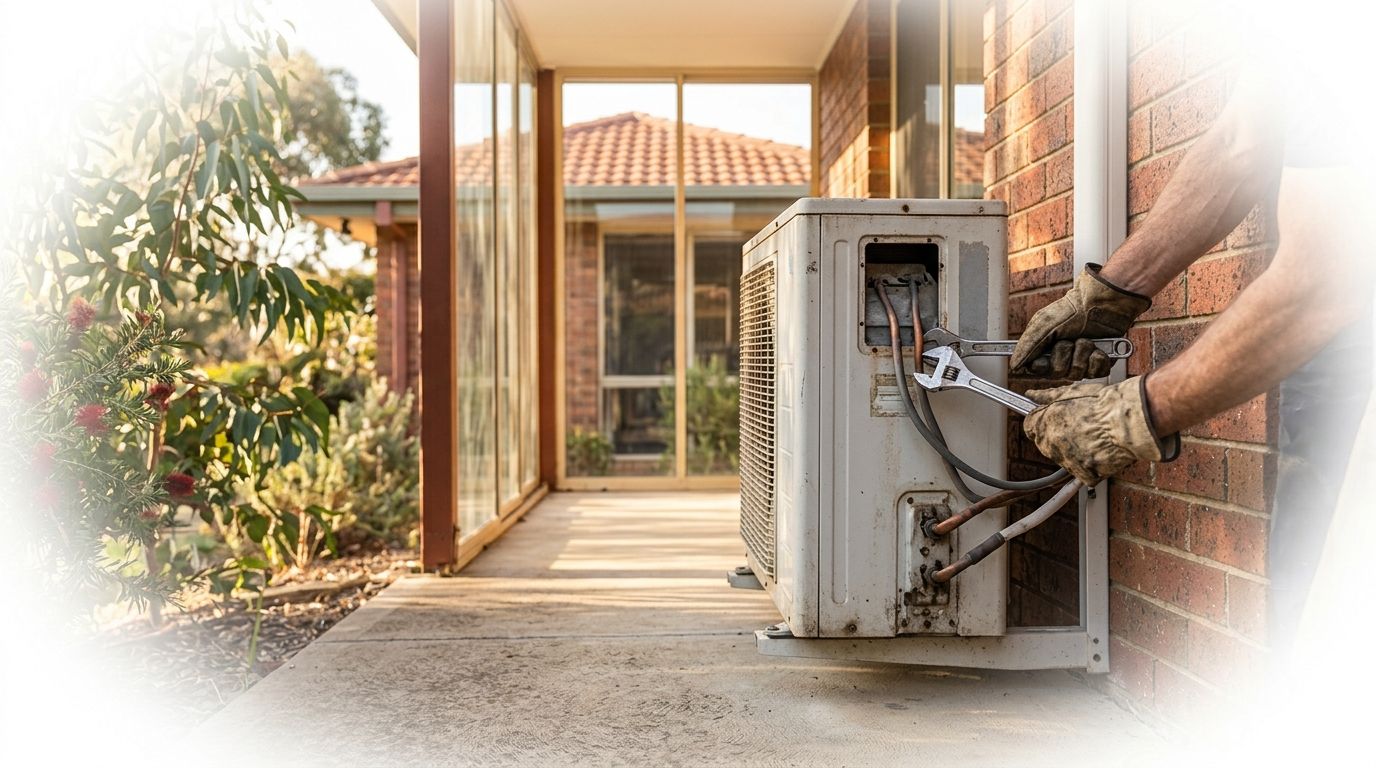
Old aircon removal is one of those jobs that catches a lot of Australians off guard. You've got a dead or outdated unit sitting on the wall, you want it gone, and your first instinct is to pull it down and toss it in the skip. The problem is that's actually illegal, and it can attract serious fines. Air conditioners are not ordinary household waste, and the rules around disposing of them properly are stricter than most people realise.
The reason comes down to what's inside the unit. Air conditioners contain refrigerant gases such as R410A and the older R22, both of which are classified as controlled substances under Australian law. These gases must be recovered by a licensed technician before the unit is moved or scrapped. Venting them into the atmosphere is an offence under federal legislation, and the environmental consequences are significant.
This guide covers everything you need to know: the legal requirements around refrigerant recovery, what your old unit is actually made of, how to find a legitimate disposal or recycling option, what it's likely to cost, and how to decide whether replacing the unit makes more financial sense than simply removing it.
Key takeaways
Disposing of an air conditioner responsibly in Australia is a legal requirement, not just a courtesy to the environment. The refrigerants inside your unit are potent greenhouse gases, and the unit itself contains valuable materials that can be recovered and recycled. Getting the process right is straightforward once you understand what's involved and who needs to do it.
Refrigerant is the chemical compound that circulates through your air conditioner to transfer heat. The two most common types found in Australian homes are R410A, which is still widely used in systems installed over the past 15 years, and R22, which was banned from new systems in 2003 but is still present in many older units still in service today.
R22 is an ozone-depleting substance with a global warming potential roughly 1,810 times that of carbon dioxide. R410A, while not ozone-depleting, has a global warming potential of around 2,088. Releasing either gas into the atmosphere during removal or disposal causes real, measurable environmental harm.
Under the Ozone Protection and Synthetic Greenhouse Gas Management Act 1989, only a technician holding a valid ARC licence can legally recover refrigerant from an air conditioning system. This applies whether the unit is being decommissioned, relocated or scrapped. The technician uses specialised recovery equipment to capture the refrigerant safely before the unit is disconnected. Skipping this step and venting the gas directly can result in fines of tens of thousands of dollars for individuals and significantly more for businesses. Beyond the legal risk, it simply isn't worth the environmental damage.
If you're booking someone to remove your old unit, always confirm they hold a current ARC licence before they touch the system.
Once the refrigerant has been safely recovered, the physical components of your old air conditioner are actually quite recyclable. A typical split system or ducted unit contains copper refrigerant coils, aluminium fins, a steel casing, circuit boards and various plastic panels. These are all materials that recycling centres and scrap metal processors can handle.
Copper and aluminium in particular carry real scrap value, which means some recyclers will accept old air conditioning units at little or no cost once the refrigerant has been removed. The circuit boards can be processed for precious metal recovery, and the steel casing is straightforward to recycle. Sending these materials to landfill wastes recoverable resources and adds unnecessary volume to waste streams. Choosing a recycler over a skip is almost always the better option, and in some cases it can offset part of your disposal cost.
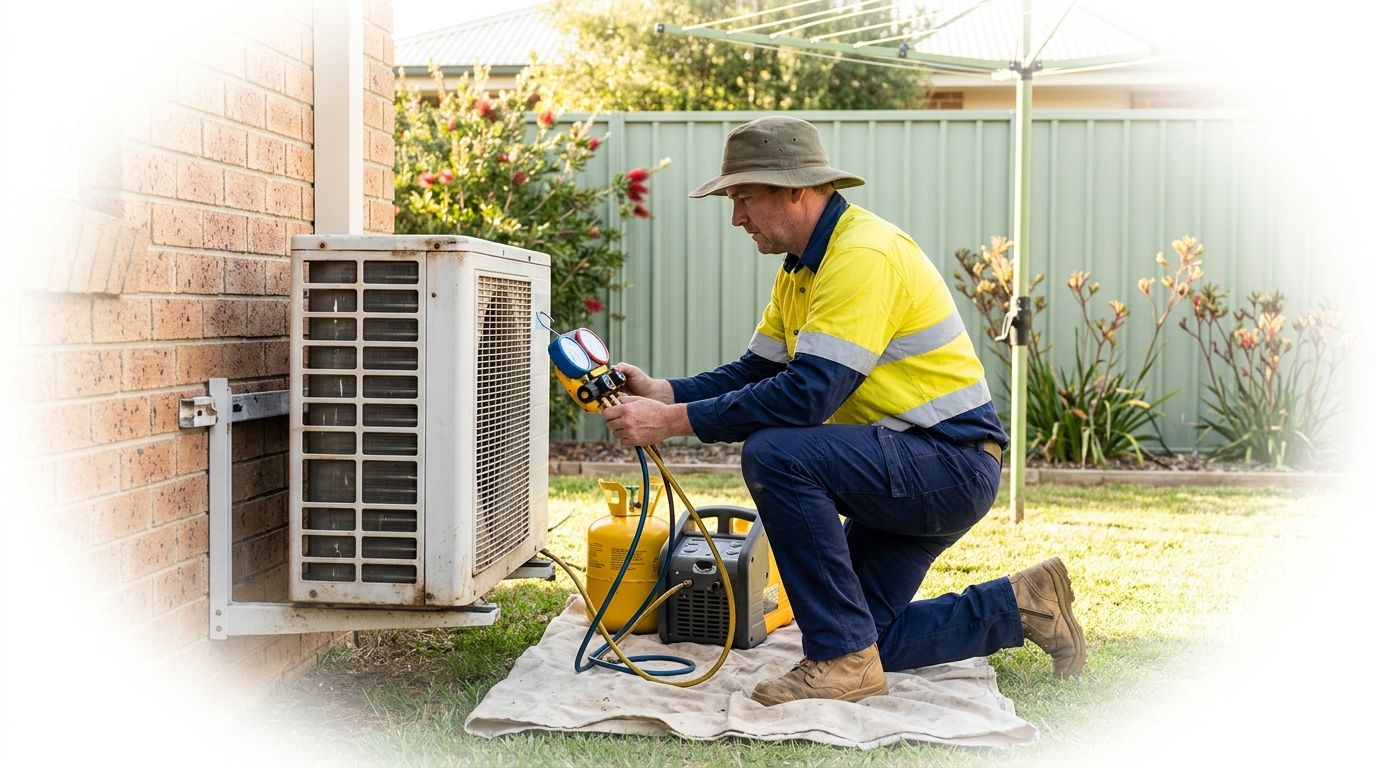
Removing an old air conditioner in Australia involves five distinct steps, and the order matters. Refrigerant must be recovered by a licensed technician before anything else happens. Skipping or reordering these steps puts you at legal risk and can result in fines. Here is the full process from decision to disposal.
Most Australian councils accept air conditioners through hard rubbish collection or dedicated e-waste drop-off events, but only after the refrigerant has been legally removed. Placing a unit containing refrigerant on the kerb for hard rubbish is not compliant and can attract fines. Check your local council website for collection schedules and the list of accepted items before putting anything out.
Councils in NSW and Victoria tend to have the most accessible options, with many offering permanent e-waste drop-off points that accept air conditioning units year-round rather than just at scheduled collection events. Some metropolitan councils also partner with recycling organisations that handle the full material recovery process once the unit arrives. It is worth calling ahead to confirm your unit will be accepted, as size and weight limits can apply.
Once refrigerant has been recovered, your old air conditioner has genuine material value. The copper coils and aluminium fins inside a typical split system are commodities that scrap metal dealers actively want. Depending on the size of the unit and current metal prices, some dealers will accept a degassed unit at no charge, and a few will pay a small amount for it.
Call ahead before you drop anything off. Scrap dealers will ask whether the unit has been degassed, and most will refuse to accept it if you cannot confirm this. Bring any paperwork from the ARCtick technician if you have it. Recycling centres that handle e-waste are another solid option, particularly for older units where the circuit boards can be processed for precious metal recovery alongside the copper and aluminium.
For most homeowners, the most practical disposal option is to have the old unit removed as part of a new installation. A licensed installer handles refrigerant recovery, electrical disconnection and physical removal in a single visit, so you are not coordinating multiple trades or arranging separate disposal. If you are already paying for air conditioning installation in Sydney, bundling the old unit removal into the same job saves time and usually reduces the overall cost compared to booking a standalone removal.
Frozone Air handles old aircon removal as part of new split system and ducted installations. The technician arrives with the recovery equipment, degasses the existing unit, disconnects it safely and takes it away before fitting the new system. It is a straightforward process that removes the compliance headache from your side entirely.
Whether to repair or replace an old air conditioner comes down to three factors: the unit's age, the cost of the repair relative to its age, and the type of refrigerant it uses. A unit that fails all three tests is almost always cheaper to replace than to fix, and a modern inverter system will cut your running costs significantly on top of that.
Most split systems have a realistic service life of 10 to 15 years. Ducted systems, which tend to be larger and more robustly built, typically last 15 to 20 years with regular servicing. If your unit is approaching or past these thresholds, even a successful repair is likely to be followed by another failure within a year or two. At that point you are spending money to delay the inevitable.
A widely used HVAC industry guideline helps cut through the uncertainty: multiply the unit's age in years by the estimated repair cost in dollars. If the result exceeds $5,000, replacement is generally the more cost-effective choice. This is a rule of thumb, not a regulation, but it gives you a useful reference point before committing to a repair bill.
As a worked example, say you have a 12-year-old split system and a technician has quoted $500 to fix a faulty fan motor. Twelve multiplied by $500 equals $6,000, which exceeds the $5,000 threshold. That result suggests replacement is the smarter financial move, even though the repair itself sounds relatively affordable in isolation.
If your unit runs on R22, the decision is straightforward: replace it. R22 was banned from new air conditioning systems in Australia in 2003 and is no longer available for regassing. A technician cannot legally recharge an R22 system with new refrigerant, which means any repair that involves a refrigerant leak is effectively uneconomical. The unit cannot be restored to full working order.
Modern inverter split systems use R32 or R410A refrigerant and are dramatically more efficient than the fixed-speed units common in Australian homes 15 or more years ago. The Daikin Cora 2.5kW split system, for example, runs on R32 and delivers significantly lower running costs than an older R22 unit of the same capacity. The Mitsubishi Electric MSZ-AP Series 2.5kW is another popular entry-level inverter option that Frozone Air installs regularly, and the Fujitsu ASTG09KMCA 2.5kW is a third well-regarded choice across all three major brands. If you have decided replacement is the right call, our guide to the best split system air conditioners in Australia covers the top picks by room size to help you choose the right model.
Old aircon removal in Australia typically costs between $80 and $600 depending on the type of system, its size and how accessible it is. A standalone split system removal including refrigerant recovery generally runs $150 to $300, while ducted system removal can exceed $600 for larger or harder-to-access installations. Bundling removal with a new installation is almost always the most cost-effective approach.
| Removal Scenario | Estimated Cost | Notes |
|---|---|---|
| Refrigerant recovery only (licensed technician) | $80 – $150 | Required before any other removal work. Must be performed by an ARCtick-licensed technician. |
| Split system removal only (no new install) | $150 – $300 | Includes refrigerant recovery, electrical disconnection and physical removal of indoor and outdoor units. |
| Ducted system removal only | $300 – $600+ | Cost varies significantly with system size, number of zones and ceiling space access difficulty. |
| Removal as part of a new installation | $0 – $150 extra | Often included or heavily discounted when bundled with a new system install. Best value option for most homeowners. |
| Council e-waste drop-off (after degassing) | Free | Unit must be fully degassed by a licensed technician first. Check your local council for accepted items and schedules. |
Prices vary by location, system size and access difficulty. A ground-floor outdoor unit on a concrete pad is straightforward to remove. A rooftop condenser or a ducted system buried in a tight ceiling cavity will take longer and cost more. Always get a written quote before work begins.
One point worth being clear on: attempting to remove your own unit without having the refrigerant recovered first is illegal under federal law and can result in fines of tens of thousands of dollars for individuals. The refrigerant recovery step is not optional, and it cannot be done by an unlicensed handyman or a general tradesperson. Only a technician holding a current ARC licence can legally perform this work.
If you are planning to replace your old unit at the same time, understanding the full cost picture is worth doing before you book. Our breakdown of air conditioning installation costs in Australia covers supply, installation labour and any additional electrical work you might need, so you can budget accurately from the start.
You can physically unmount the indoor and outdoor units yourself once the refrigerant has been legally recovered by a licensed ARCtick technician. However, you cannot disconnect the electrical wiring or handle the refrigerant lines without the appropriate licences. Attempting to vent or release refrigerant yourself is a federal offence and can attract significant fines.
Once a licensed technician has recovered the refrigerant, you can dispose of the unit through your local council's hard rubbish collection or e-waste drop-off, a scrap metal dealer or recycling centre, or by having your installer take it away as part of a new system installation. Never place a unit containing refrigerant on the kerb or in a skip bin.
Yes. Disposing of an air conditioner that still contains refrigerant is illegal under the Ozone Protection and Synthetic Greenhouse Gas Management Act 1989. Refrigerant gases must be recovered by a licensed technician before the unit is scrapped, recycled or placed for council collection. Fines for illegal venting can reach tens of thousands of dollars for individuals.
A standalone split system removal including refrigerant recovery typically costs between $150 and $300 in Australia. If you are having a new system installed at the same time, removal is often included or available for $0 to $150 extra, making a bundled job the most cost-effective option for most homeowners.
Old aircon removal comes down to three non-negotiables: a licensed ARCtick technician must recover the refrigerant before anything else happens, the unit needs to go through a legitimate disposal pathway rather than a skip bin, and bundling removal with a new installation is the most cost-effective and convenient option for most homeowners in Sydney and Melbourne.
Frozone Air handles the full process. Our licensed technicians arrive with recovery equipment, degas your existing unit, disconnect it safely and take it away before fitting your new system. There is no need to coordinate multiple trades or chase council collection schedules.
To get a free quote for old aircon removal and new system installation, call us on 1300 801 839 or book online through our installation page. We service Sydney and Melbourne, and our team can advise on the right replacement unit for your home once the old one is out of the way.