

How Does an Evaporative Air Conditioner Work — And Is It Right for Your Home?
Wondering how does an evaporative air conditioner work? We explain the science, pros, cons, and whether it suits your Australian home.


Wondering how does an evaporative air conditioner work? We explain the science, pros, cons, and whether it suits your Australian home.
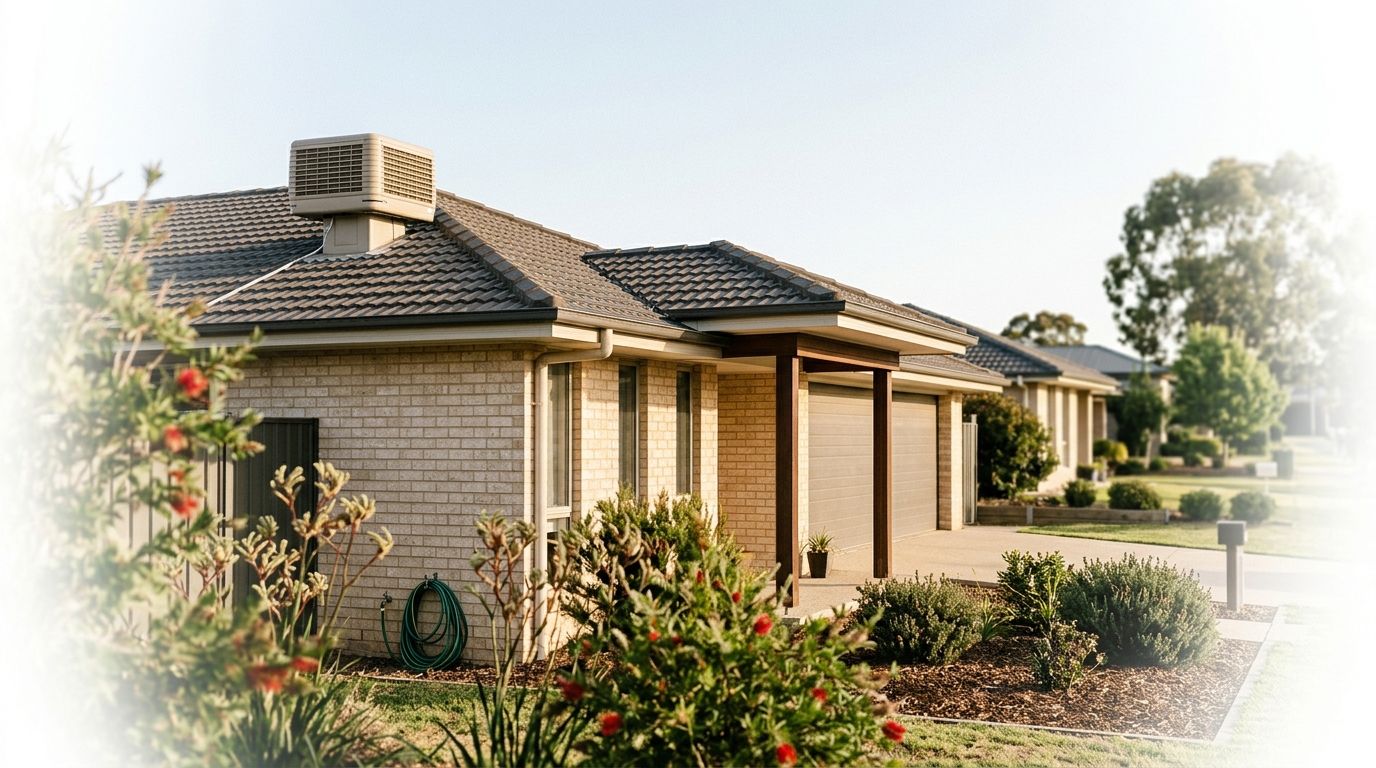
Australian summers can be brutal, and running a refrigerated air conditioner all day adds up fast on the power bill. That is why so many homeowners across inland and regional Australia ask how does an evaporative air conditioner work, and whether it could be a cheaper alternative for their home. The short answer is that it uses the natural cooling power of water evaporation to drop the temperature of incoming air, and it costs a fraction of a refrigerated system to run.
This article covers the science behind evaporative cooling, the two main system types, where it performs best, its real limitations, and how it stacks up against refrigerated air conditioning. By the end you will have a clear picture of whether it suits your home and climate.
Key takeaways
Evaporative cooling works on a principle you have already experienced: step out of a pool on a hot day and you feel cold almost instantly. That chill is water evaporating from your skin and carrying heat energy away with it. An evaporative air conditioner does exactly the same thing, just at scale inside a purpose-built unit.
Here is how the process works in a typical residential system. A fan draws hot outside air through a set of water-saturated cooling pads. As the water in those pads evaporates, it absorbs heat from the passing air, dropping the air temperature by roughly 10 to 15 degrees Celsius before it is pushed into the home. On a 40°C day in a dry inland climate, that can mean air entering your living room at around 25 to 28°C.
Because the process involves water evaporating into the air stream, it also adds moisture to the air. In dry climates like Adelaide, Perth or inland New South Wales, that added humidity is genuinely comfortable. It stops the air feeling harsh and parched, which is a common complaint with refrigerated systems running in very dry conditions.
The main components of an evaporative unit are straightforward. The outer housing contains a water reservoir, a small pump that continuously wets the cooling pads, the pads themselves (usually made from cellulose or synthetic fibre), and a fan or blower that moves air through the system and into the home. Most units also include a 'vent-only' mode that runs the fan without activating the pump, which is handy on mild days when you just want fresh air circulating without the added moisture.
There are two main ways an evaporative system can be installed in a home. A direct (or 'room') unit delivers cooled air straight from the unit into a single room or open-plan space through a ceiling or wall outlet. These are simpler and cheaper to install, and they suit smaller homes, granny flats or situations where whole-home cooling is not required.
A ducted evaporative system connects the central unit to a network of ceiling vents throughout the home, delivering cooled air to multiple rooms at once. This is the most common residential choice in Australia, particularly in Victoria, South Australia and Western Australia where the climate suits evaporative cooling well. For larger homes, ducted air conditioning via an evaporative system is often significantly cheaper to run than a ducted refrigerated alternative.
Most ducted evaporative units are roof-mounted, which keeps them out of the way and makes duct runs straightforward. However, many technicians prefer ground-mounted horizontal units where the roof pitch and structure allow for it. Ground-mounted units are easier to service, reducing labour time and cost at each maintenance visit, and they eliminate the risk of water leaks from a rooftop installation causing ceiling damage over time. It is worth discussing the mounting option with your installer before committing to a position.

Evaporative cooling performs best in hot, dry climates where the ambient humidity is consistently low, typically below 40 to 50%. That makes it a strong fit for inland and semi-arid regions including Adelaide, Perth, Melbourne's northern and western suburbs, and much of regional Victoria and New South Wales. In these areas, a well-sized ducted evaporative system can keep a whole home genuinely comfortable through summer without the running costs of a refrigerated alternative.
The picture changes significantly on the coast. Sydney and Brisbane regularly see summer humidity above 60%, and during humid heatwaves it can sit above 80% for days at a time. At those humidity levels, the air is already close to saturated, so very little additional water can evaporate from the cooling pads. The result is that the unit moves air around the house without delivering much of a temperature drop, which is frustrating when you are paying to run it.
The table below summarises the key trade-offs to weigh up before committing to an evaporative system.
| Factor | Pros | Cons |
|---|---|---|
| Running costs | 50 to 75% cheaper to run than a comparable refrigerated system | Costs rise if you run it at high fan speeds for extended periods |
| Installation cost | Generally lower upfront cost than ducted refrigerated systems | Roof penetrations and ductwork still add to the total installed price |
| Air freshness | Continuously draws in fresh outside air rather than recirculating stale air | Brings in outdoor air, so pollen and dust can enter if pads are not maintained |
| Humidity performance | Adds comfortable moisture in very dry inland climates | Ineffective when outdoor humidity exceeds 50 to 60% |
| Water usage | No refrigerant required, no greenhouse gas emissions from the cooling cycle | Uses 25 to 60 litres of water per hour depending on capacity and conditions |
| Extreme heat | Handles dry 40°C+ days well in low-humidity climates | Performance drops sharply on humid days regardless of temperature |
For a thorough side-by-side breakdown of both technologies, including efficiency ratings and long-term cost comparisons, see our dedicated article on evaporative cooling vs air conditioning.
Evaporative coolers have two operating inputs to budget for: electricity and water. On both counts they are cheaper to run than refrigerated systems in dry climates, but the water consumption in particular is worth understanding before you commit.
On the electricity side, a whole-home ducted evaporative unit typically draws between 1 and 2 kilowatts, covering the pump and the fan motor. A comparable ducted reverse-cycle refrigerated system draws 3 to 6 kilowatts to run the compressor, fan and controls. That difference adds up quickly over a long summer. Running an evaporative system for eight hours a day at 1.5 kW costs roughly half what you would spend running a 4 kW refrigerated unit for the same period, and the gap widens further if you are in a climate where the evaporative system can handle most of the season without needing a backup.
Water consumption is the honest trade-off. A ducted evaporative unit uses approximately 25 to 60 litres of water per hour, depending on the unit's capacity, the fan speed selected and how dry the outside air is. On a hot, dry day the pads evaporate water faster, so consumption sits toward the higher end of that range. Over a full summer of regular use, that adds a meaningful amount to your water bill, and it is worth factoring in if you are on tank water or in an area with water restrictions.
Running costs also vary with fan speed. Most ducted systems offer three to five speed settings, and dropping from high to medium speed can reduce both electricity draw and water consumption noticeably without a dramatic loss of cooling output. Getting the right balance for your home is something a good installer will walk you through at commissioning.
For detailed figures on supply, installation and ongoing running costs, our guide to evaporative air conditioning costs in Australia covers the full picture.
Whether an evaporative air conditioner suits your home comes down to three things: your climate, your floor plan and how you use the space. For some households it is the most practical and cost-effective cooling solution available. For others, it will underdeliver from day one. Here is an honest breakdown of where it fits and where it does not.
If you are in Adelaide, Perth, Canberra or inland New South Wales and Victoria, evaporative cooling is genuinely hard to beat on value. A ducted Rinnai evaporative system, which Frozone installs and services, will keep an open-plan home comfortable through a dry summer at a fraction of the running cost of a refrigerated alternative. The continuous fresh air circulation is a real bonus for families who find recirculated refrigerated air stuffy. Open-plan layouts work especially well because the system needs windows or doors slightly ajar to exhaust the air it pushes in, and that is easy to manage in a home designed around open living.
If you are in Sydney, Brisbane or anywhere along the coast, evaporative cooling is a poor match for your climate. High summer humidity means the pads cannot evaporate water effectively, so the unit moves warm, moist air around the house rather than cooling it. Homes with multiple closed bedrooms also struggle, because the system needs somewhere for air to escape. Households with allergy sufferers should be cautious too. Evaporative systems draw in unfiltered outside air, and without diligent pad maintenance, they can introduce pollen, dust and mould spores into the home.
If your home needs reliable cooling regardless of humidity, or you want a single system that handles both heating and cooling, a reverse-cycle split system or ducted refrigerated system will serve you better. For Sydney and coastal homeowners, the Daikin Cora range and the Mitsubishi Electric MSZ-AP series are two of the most popular options Frozone installs. Both deliver consistent performance in humid conditions, include reverse-cycle heating and carry strong energy star ratings. The upfront cost is higher than an evaporative system, but the year-round versatility often makes the investment worthwhile.
If you are unsure which direction to go, talking to a professional before you commit is the smartest move. A good installer will assess your climate zone, floor plan and usage patterns and give you a straight answer. Reach out to the Frozone team for professional air conditioning installation advice tailored to your home.
Evaporative cooling does not work well in humid weather. The process relies on water evaporating from the cooling pads to lower the air temperature, and that evaporation slows dramatically when the outside air is already carrying a lot of moisture. In climates where summer humidity regularly exceeds 50 to 60%, such as Sydney or Brisbane, a refrigerated system will deliver far more reliable comfort.
A ducted evaporative air conditioner uses approximately 25 to 60 litres of water per hour, depending on the unit's capacity, the fan speed and how dry the outside air is. On a hot, dry day the pads evaporate water faster, pushing consumption toward the higher end of that range. Over a full summer of regular use, this adds a noticeable amount to your water bill, so it is worth factoring in if you are on tank water or in an area with seasonal water restrictions.
No. An evaporative cooler must be run with windows or doors slightly open to allow the air it pushes into the home to escape. Without an exhaust path, pressure builds up inside the house and the system cannot move air through effectively, which kills its cooling performance. As a general rule, open a window or door in each room you want to cool by about 5 to 10 centimetres.
An evaporative cooler should be serviced at least once a year, ideally before the cooling season begins in spring. A standard service includes inspecting and replacing the cooling pads, cleaning the water reservoir and pump, checking the fan belt and motor, and flushing any mineral scale that has built up over winter. Skipping annual maintenance is the most common reason evaporative systems underperform or develop mould and odour problems.
Evaporative cooling is a genuinely cost-effective, energy-efficient option for the right home in the right climate. In dry inland areas it is hard to beat on running costs and fresh air quality. But it is not a universal solution, and fitting the wrong system to your home is an expensive mistake to make.
The Frozone team installs and services evaporative systems across Australia, and we give straight advice based on your climate zone, floor plan and budget. If you are weighing up evaporative cooling against a refrigerated alternative, we can walk you through the numbers and help you make a confident decision before you spend a cent.
Call us on 1300 801 839 or request a free quote online and one of our cooling specialists will get back to you. If you are already leaning toward a refrigerated split system, our best split system air conditioner guide covers the top-rated models by room size to help you narrow down your options.