

Air Conditioner Dry Mode vs Cool Mode: What's the Difference?
Confused by the air conditioner dry setting? Learn how dry mode differs from cool mode, when to use each, and which saves more energy in Australian conditions.


Confused by the air conditioner dry setting? Learn how dry mode differs from cool mode, when to use each, and which saves more energy in Australian conditions.
You know the feeling: it's 26°C outside, not exactly a scorcher, but the air is so thick and sticky that you feel like you're breathing through a wet towel. That's humidity at work, and it's one of the most common comfort complaints across coastal and subtropical Australia. The air conditioner dry setting exists specifically to tackle this problem, pulling excess moisture from the air rather than simply blasting cold air into the room. Most people reach straight for cool mode without realising dry mode is even there.
Most modern split systems offer several operating modes, including cool, heat, fan, auto and dry. Each one serves a different purpose, and understanding which to use can save you money and make your home genuinely more comfortable. For a broader overview of all the modes on your unit, the air conditioner modes explained guide is a good place to start.
This article focuses specifically on dry mode versus cool mode: how each one works, when to use which, and which costs less to run.
Key takeaways
Dry mode works by running the air conditioner's compressor to cool the evaporator coil below the dew point of the room air, causing moisture to condense on the coil and drain away through the unit's condensate line. The result is air that is returned to the room with less moisture in it, making the space feel less clammy and more comfortable. The primary goal is dehumidification, not cooling.
The key difference between dry mode and cool mode is fan speed. In cool mode, the fan runs at whatever speed you set to push as much conditioned air into the room as possible. In dry mode, the fan runs at a very low speed deliberately. Slowing the airflow down gives the warm, humid room air more contact time with the cold evaporator coil, which maximises the amount of moisture that condenses out before the air is returned to the room.
Because the fan is running slowly, you will notice the airflow feels gentle and quiet. The unit is not trying to flood the room with cold air. It is methodically wringing moisture out of the air that passes through it. On most remotes, dry mode is represented by a water droplet icon. If you want to decode every symbol on your remote, the guide to aircon symbols on your remote covers all the common icons across major brands.
One thing worth knowing: dry mode does not switch the compressor on and off continuously the way cool mode does when it reaches a set temperature. Instead, the compressor cycles in short bursts to keep the coil cold enough to condense moisture without over-cooling the room. This is a gentler, more measured operation than full cool mode.
Dry mode does lower the room temperature slightly, but this is a side effect rather than the point. Because the evaporator coil is cold, some heat is removed from the air as it passes over the coil. However, with the fan running at low speed, air circulation through the room is minimal, so the cooling effect is modest and slow.
On a mild but humid day, say 26°C to 27°C with high humidity, dry mode can make a room feel dramatically more comfortable without dropping the thermostat much at all. Removing humidity lowers the 'feels like' temperature significantly, which is why dry mode can feel so effective on those sticky coastal days even though the thermometer barely moves.
On a genuinely hot day, 33°C or above, dry mode will not keep up with the heat load. The slow fan speed and modest compressor cycling simply cannot shift enough heat out of the room fast enough. On those days, cool mode is the right tool. Dry mode is best understood as a comfort mode for mild, humid conditions rather than a substitute for active cooling on a hot Australian summer afternoon.
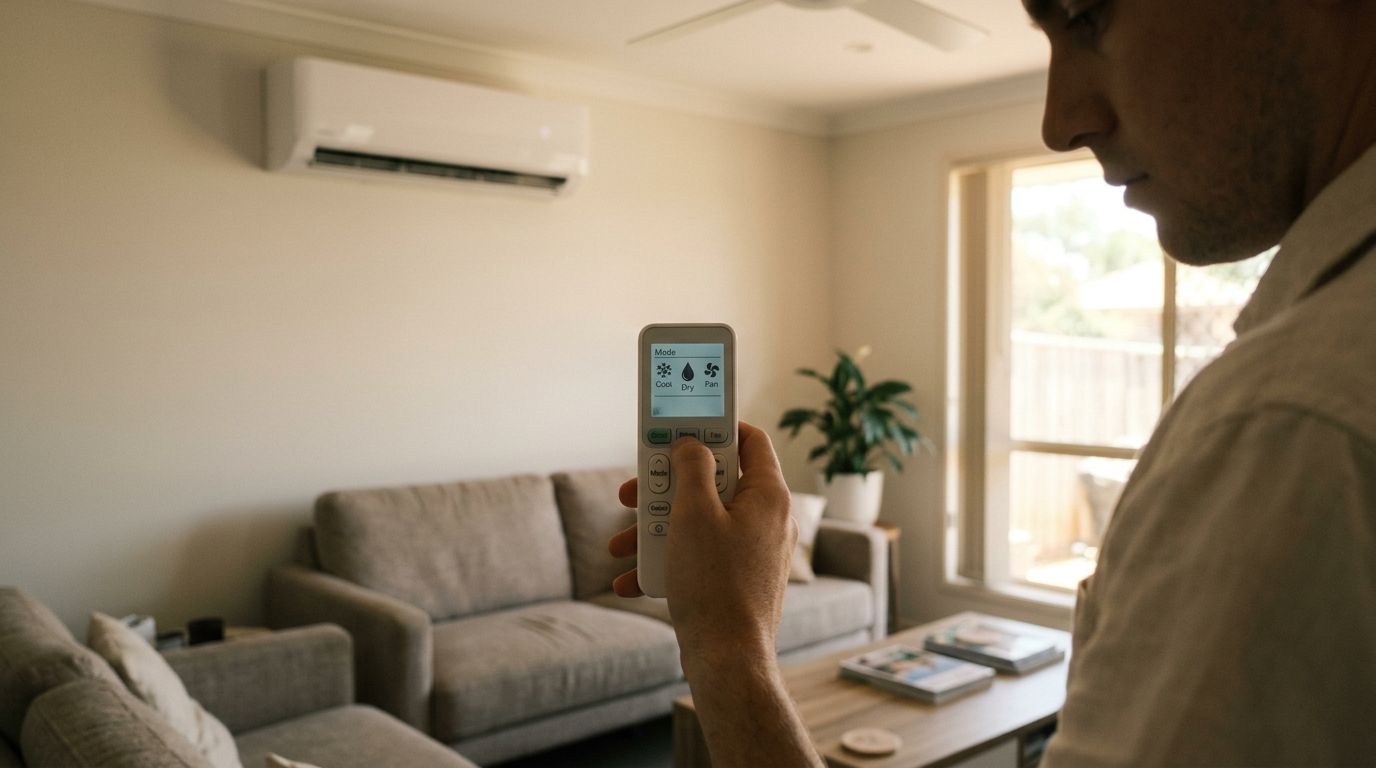
Dry mode and cool mode both use the same refrigeration cycle inside your air conditioner, but they are tuned for completely different jobs. Dry mode runs a slow fan to maximise moisture removal with minimal cooling, while cool mode runs the fan at full speed to actively push cold air through the room and drop the temperature as fast as possible. Knowing which to reach for depends on whether your problem is humidity or heat.
| Feature | Dry Mode | Cool Mode |
|---|---|---|
| Primary Purpose | Remove excess humidity from the air | Actively lower room temperature |
| Fan Speed | Fixed at very low speed to maximise moisture contact with the coil | User-selectable; typically runs at medium to high speed |
| Temperature Drop | Minimal; slight cooling is a side effect, not the goal | Significant; designed to reach and hold a set temperature |
| Energy Use | Lower; compressor cycles in short bursts, fan draws little power | Higher; compressor and fan run harder to shift heat out of the room |
| Best Conditions | Mild, humid days (24°C to 27°C) with humidity above 70% | Hot days above 28°C to 30°C where temperature reduction is the priority |
The short version: reach for cool mode on a genuinely hot day when you need the temperature to come down fast. Switch to dry mode on those mild, muggy days where the air feels sticky but it is not actually that warm. The two modes work well together as well. Running dry mode in the morning when humidity is at its peak strips moisture from the air first, which means cool mode has less work to do as the day heats up and can reach your target temperature more efficiently. That combination is one of the simplest ways to get more comfort out of your system without running it harder.
The air conditioner dry setting is most useful in three specific situations: mild but humid weather, damp conditions after rain and as a morning pre-treatment before switching to cool mode. Understanding these scenarios helps you get real comfort benefits from a mode that most people ignore entirely.
If the temperature is sitting between 24°C and 27°C but the humidity is above 70%, dry mode is almost always the better choice over cool mode. This is the classic coastal Australian summer scenario, common in Sydney, Wollongong, Newcastle and up through the Queensland coast. During La Niña periods, these conditions can persist for weeks at a time, making dry mode a genuinely useful daily tool rather than a novelty setting.
At these temperatures, cool mode often over-cools the room to achieve any meaningful comfort improvement. Dry mode addresses the actual problem, which is the moisture in the air, without leaving you reaching for a jumper an hour later.
After heavy rain or a run of overcast, wet days, the moisture does not just stay outside. Walls, carpets, soft furnishings and curtains absorb humidity, and the air inside the home can feel damp and stale even with windows closed. This is also when mould risk increases, particularly in bedrooms and bathrooms with limited airflow.
Running dry mode for a few hours after a rain event pulls that excess moisture out of the air before it has a chance to settle into surfaces. Units like the Daikin Cora series (for example the FTKM25WVMA 2.5kW) and the Mitsubishi Electric MSZ-AP series (such as the MSZ-AP25VGD 2.5kW) handle extended dry mode operation well thanks to their inverter-driven compressors, which modulate output smoothly rather than hammering on and off at full power. The Fujitsu ASTG series (for example the ASTG09KMCA 2.5kW) is another solid option across all three scenarios covered here.
Humidity is typically highest in the early morning, especially after a warm overnight period. Running dry mode for 30 to 60 minutes before the day heats up removes that moisture load from the air first, so when you switch to cool mode mid-morning the unit is not fighting both heat and humidity at the same time. The result is faster temperature drop and lower overall energy use across the day. For more practical tips on getting your home to temperature quickly, the guide on how to cool your home faster is worth a read.
Dry mode is not the right tool for every situation. On very hot days above 30°C, the slow fan speed and modest compressor cycling simply cannot shift enough heat to keep the room comfortable. Cool mode is the correct choice on those days. Dry mode is also unnecessary in already dry climates, such as inland areas of New South Wales, Victoria and South Australia, where relative humidity is often below 50% and further dehumidification will just make the air uncomfortably dry.
It is also worth noting that not all units are designed for extended dry mode operation over many consecutive hours. Check your owner's manual for any guidance on run time limits, or contact a qualified technician if you are unsure how your specific model handles prolonged use in this mode.
Dry mode does use less electricity than cool mode per hour of operation. The compressor runs at a lower capacity and cycles in short bursts rather than sustained output, and the fan draws very little power at its slow fixed speed. On a mild, humid day where dry mode is genuinely the right choice, you will spend less on running costs than if you had reached for cool mode instead. To understand exactly how much power your air conditioner uses across different modes, the full breakdown is worth reading before you estimate your electricity costs.
The honest caveat is that dry mode is not a 'free' or universally cheaper option. If you run dry mode on a genuinely hot day, say 33°C or above, the unit will struggle to keep the room comfortable. The slow fan and modest compressor cycling cannot shift enough heat, so the room stays warm and you end up running the unit for longer to achieve any relief. In that scenario, dry mode costs you more overall than simply switching to cool mode and letting the unit do its job efficiently.
The real saving comes from matching the mode to the conditions. On a 26°C day with 80% humidity, dry mode addresses the actual problem quickly and cheaply. On a 35°C scorcher, cool mode is the more efficient choice even though it draws more power per hour, because it solves the problem faster and stops running sooner.
Modern inverter split systems handle this particularly well. Units like the Daikin Cora series (for example the FTKM25WVMA 2.5kW) and the Mitsubishi Electric MSZ-AP series (such as the MSZ-AP25VGD 2.5kW) use variable-speed compressors that modulate output precisely across all modes, including dry. The Fujitsu ASTG series (for example the ASTG09KMCA 2.5kW) works the same way. Rather than switching the compressor on and off at full power, these units ramp up and down smoothly, which keeps energy consumption low and avoids the efficiency losses that come with constant hard cycling. On an older fixed-speed unit, the difference between modes is more pronounced. On a modern inverter system, the gap narrows, but dry mode still draws less power than cool mode under equivalent conditions.
Running dry mode for several hours is fine on a mild, humid day and most modern split systems handle extended operation without issue. However, running it all day in already dry conditions will strip too much moisture from the air, leaving the space uncomfortably dry and potentially irritating airways. Check your owner's manual for any guidance on continuous run times for your specific model.
Dry mode does lower the room temperature slightly as a side effect of the refrigeration process, but cooling is not its purpose. The temperature drop is modest because the fan runs at a very low speed, limiting how much air passes over the cold evaporator coil. On a hot day above 30°C, this incidental cooling will not be enough to keep the room comfortable.
Use dry mode in summer when the temperature is mild, roughly 24°C to 27°C, but the air feels sticky and humid. Switch to cool mode once the temperature climbs above 28°C to 30°C and your priority is bringing the room temperature down. On many Australian summer mornings, running dry mode first and then switching to cool mode as the day heats up is the most efficient approach.
Yes, removing humidity is the primary function of dry mode. The air conditioner cools its evaporator coil below the dew point of the room air, causing moisture to condense on the coil and drain away through the condensate line. The air returned to the room has measurably less moisture in it, which lowers the 'feels like' temperature and reduces that clammy, uncomfortable sensation common in coastal and subtropical parts of Australia.
The core distinction is straightforward: dry mode removes humidity on mild, sticky days when the temperature is comfortable but the air feels clammy, while cool mode actively lowers room temperature on genuinely hot days. Both modes have a real place in your daily routine, and using them correctly rather than defaulting to cool mode every time can meaningfully improve comfort and trim your running costs across a long Australian summer.
If you're in Sydney, Melbourne or anywhere in between and you're not getting the comfort you expect from your system, or you suspect it's not performing as it should, the team at Frozone Air can help. Call us on 1300 801 839 to get advice or book a service with one of our qualified technicians.
If your current unit is older and lacks the inverter technology that makes both dry and cool mode run efficiently, it may be worth considering an upgrade. Browse our range of split system air conditioning options to find a modern inverter system suited to your home and climate.