

Evaporative Cooling vs Air Conditioning: Which Is Better for Australian Homes?
Evaporative cooling vs air conditioning: compare running costs, performance, humidity limits and more to find the right system for your Australian home.


Evaporative cooling vs air conditioning: compare running costs, performance, humidity limits and more to find the right system for your Australian home.
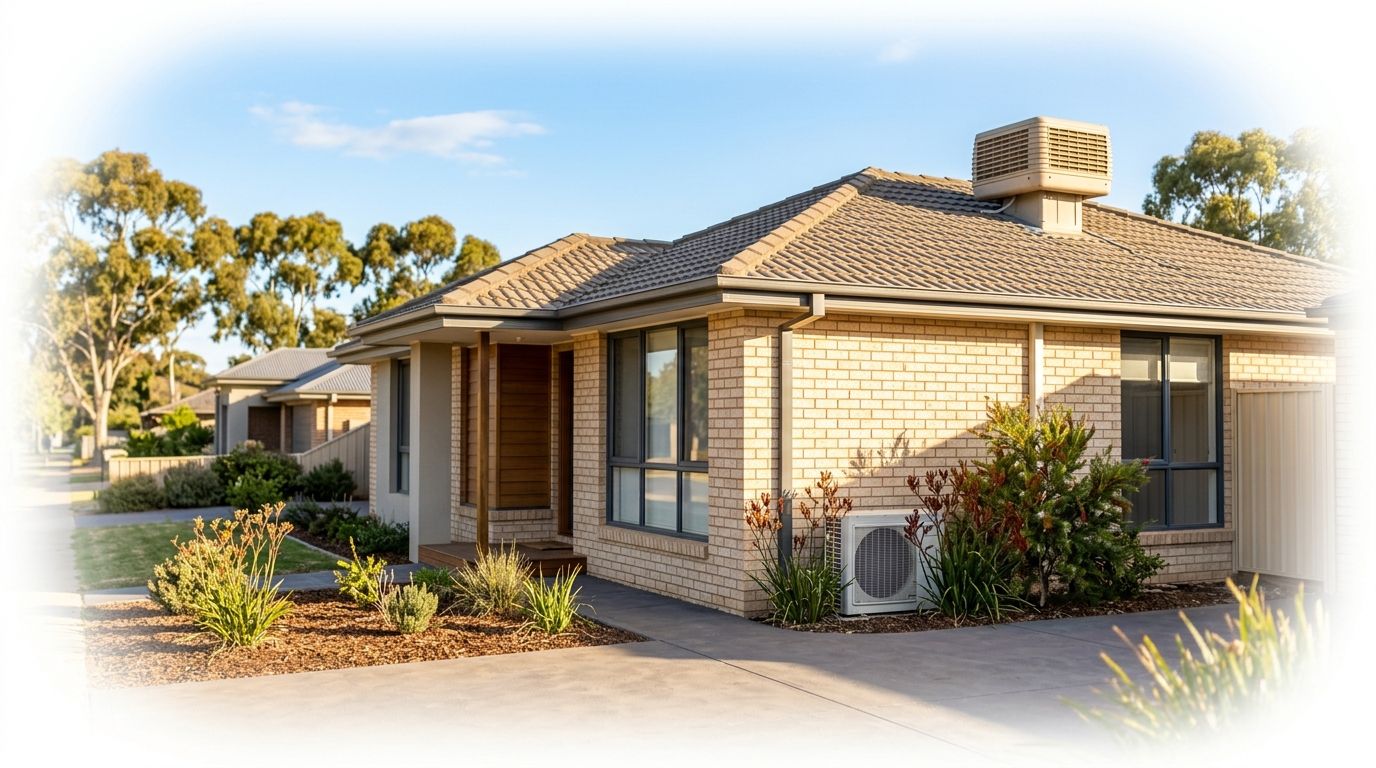
Australian summers have a way of forcing a decision: do you go with evaporative cooling or refrigerated air conditioning? Both will cool your home, but they work in completely different ways, suit different climates and come with very different running costs. The right choice depends on where you live, how you live and what you're willing to spend upfront versus over time.
Evaporative cooling draws hot outside air through water-saturated pads. As the water evaporates, it drops the air temperature by roughly 10 to 15°C before pushing that fresh air into your home. Refrigerated air conditioning uses a refrigerant cycle to physically remove heat and moisture from indoor air, then expel it outside.
This article covers the key differences across upfront cost, running costs, climate suitability, humidity performance and health considerations so you can make a confident call for your home.
Key takeaways
Understanding the mechanics behind each system makes every trade-off easier to understand. The two technologies take fundamentally different approaches to cooling, which is why they perform so differently depending on the conditions outside your window.
An evaporative cooler sits on your roof and pulls hot outside air through a series of water-soaked pads. As that air passes through the wet pads, the water evaporates and absorbs heat from the air, dropping the temperature by roughly 10 to 15°C before it's pushed through your home's ductwork. The process is continuous: fresh outside air flows in constantly, which means your windows and doors need to stay slightly open to allow the warm air already inside to escape.
Because the system works by adding moisture to the air, it performs best in hot, dry climates like inland Victoria, South Australia and Western Australia. The drier the outside air, the more effective the evaporation process. In humid conditions, the air is already carrying a lot of moisture and there's less capacity for evaporation, which means the cooling effect drops off significantly. This is the single biggest limitation of evaporative cooling and it's worth understanding before you commit.
Refrigerated air conditioning works on a closed-loop refrigerant cycle. The indoor unit draws warm air from inside your home across a cold evaporator coil, which absorbs the heat. That heat is then transferred via refrigerant to the outdoor unit, where a compressor expels it outside. The air returned to your room is both cooled and dehumidified, which is why refrigerated systems feel so effective even on humid days.
Because the system recirculates indoor air rather than drawing in outside air, doors and windows need to stay closed for the system to work efficiently. Open a door and you're letting in warm, humid air that the unit then has to work harder to cool.
The two main formats Frozone Air installs are split system air conditioning and ducted systems. Split systems are wall-mounted units that cool a single room or open-plan area and are the most popular choice for Australian homes. Ducted systems use a central unit connected to vents throughout the home, giving you whole-home climate control from a single system. Both formats use the same refrigerant cycle and perform consistently regardless of outdoor humidity.
Both systems will cool your home, but they do it differently, cost differently to run and suit different conditions. The table below puts the key factors side by side so you can see at a glance where each system wins and where it falls short.
| Feature | Evaporative Cooling | Refrigerated Air Conditioning |
|---|---|---|
| Purchase and Installation Cost | Lower upfront cost. Ducted evaporative systems typically $3,000–$6,000 installed. | Higher upfront cost. Split systems from ~$1,500 installed; ducted air conditioning from ~$8,000–$20,000+. |
| Running Cost Per Hour | ~$0.10/hr. Very low energy draw. | ~$0.60–$3.45/hr depending on system size and efficiency rating. |
| Climate Suitability | Best in hot, dry climates (inland areas, low humidity). Performs poorly above 50% relative humidity. | Effective in all Australian climates, including humid coastal regions. |
| Humidity Performance | Adds moisture to the air. Becomes ineffective and uncomfortable in humid conditions. | Removes moisture from the air. Maintains comfort regardless of outdoor humidity. |
| Heating Capability | None. Cooling only. | Yes, via reverse-cycle operation. Heats and cools from a single system. |
| Maintenance Requirements | Pads need cleaning or replacing each season. Water supply and pump require regular checks. | Annual filter cleaning and periodic professional servicing. Generally lower seasonal maintenance. |
| Environmental Impact | Low energy use. No refrigerants. Uses water continuously during operation. | Higher energy use. Uses refrigerant (modern systems use low-GWP refrigerants such as R32). |
The headline takeaway is straightforward: evaporative cooling is the clear winner on running costs and environmental footprint in dry inland climates, where it can cost up to six times less per hour to run than a refrigerated system. Refrigerated air conditioning wins on versatility, humidity control and year-round usefulness, which is why it remains the dominant choice across most of Australia. If you live somewhere with variable humidity or need heating as well as cooling, refrigerated AC is the more practical long-term investment.
The best cooling system for your home depends almost entirely on where you live and what you need it to do. Evaporative cooling and refrigerated air conditioning each have a clear home ground, and choosing the wrong one for your climate means paying for a system that underperforms when you need it most.
Evaporative cooling performs at its best in hot, low-humidity conditions, which makes it a strong fit for inland regions like western Sydney, Canberra, inland Victoria and much of South Australia and Western Australia. In these areas, summer air is dry enough for the evaporation process to deliver a genuine 10 to 15°C temperature drop, and the continuous flow of fresh air suits open-plan homes, garages and outdoor-adjacent spaces particularly well.
For budget-conscious homeowners in drier regions, the numbers are hard to argue with. A ducted evaporative system installed for $4,000–$6,000 running at roughly $0.10 per hour is a genuinely affordable way to cool a large home. The trade-off is that you need to keep windows and doors slightly open, and on the rare humid day, the system will struggle. If your local summers are consistently dry, evaporative cooling is a sensible, cost-effective choice.
Refrigerated air conditioning is the only reliable option for humid climates. Evaporative cooling adds moisture to the air as it cools, which means on a humid day it makes your home feel stickier, not more comfortable. In Sydney's eastern suburbs, coastal Melbourne and most of Queensland, summer humidity regularly climbs above 60 to 70%, which is the point where evaporative cooling stops being effective.
Modern inverter split systems handle these conditions efficiently and quietly. They dehumidify as they cool, keeping indoor air comfortable even when it's 30°C and muggy outside. For coastal homeowners, refrigerated AC is not just the better option, it's the only one that will actually do the job on the days that matter most.
If you need both heating and cooling, the choice is simple: reverse-cycle refrigerated air conditioning. Evaporative systems cannot heat. For Australian winters, that's a significant limitation. A reverse-cycle split system or ducted refrigerated system gives you cooling in summer and efficient heating in winter from a single unit, which is the main reason most Australian homeowners choose refrigerated AC over evaporative.
For whole-home year-round comfort, the investment in ducted air conditioning pays off over time, though it's worth reading up on ducted air conditioning costs in Australia before committing to a budget. For individual rooms or open-plan living areas, a quality reverse-cycle split system is the practical starting point. Frozone Air installs and recommends several strong options in this category: the Daikin Cora FTXM25Y (2.5kW) is a reliable entry-level inverter unit well suited to bedrooms and smaller living areas, the Mitsubishi Electric MSZ-AP25VGD (2.5kW) is a premium option known for whisper-quiet operation and strong energy ratings, and the Fujitsu ASTG09KMCA (2.5kW) offers competitive pricing with solid performance in humid coastal climates. If you're unsure which system suits your home, a professional assessment makes all the difference. Our team handles air conditioning installation in Sydney and can recommend the right system for your climate, home layout and budget.
Evaporative cooling costs roughly $0.10 per hour to run, while refrigerated air conditioning typically costs between $0.60 and $3.45 per hour depending on system size and efficiency. Run either system for six to eight hours a day across a full Australian summer and that gap adds up to hundreds of dollars. For many households, the running cost difference is the single most persuasive factor in the decision.
That said, the comparison is only fair if you account for what each system actually delivers. A refrigerated system running at $1.50 per hour on a 35°C humid day is doing a job an evaporative cooler simply cannot do in those conditions. The lower running cost of evaporative cooling only represents real savings if the system is effective in your climate.
Evaporative coolers need more hands-on seasonal attention than most people expect. The cooling pads absorb minerals from the water supply over time and need to be cleaned at the start of each cooling season and replaced every one to two seasons depending on your water quality. The water supply line, pump and distribution system also need checking regularly to prevent scale build-up and ensure the pads stay evenly saturated. Skipping this maintenance leads to reduced cooling performance and, in some cases, mould growth in the ductwork.
Refrigerated air conditioning is lower maintenance by comparison. Filters should be cleaned every four to six weeks during heavy use, which is a simple task most homeowners handle themselves. A professional service every two to three years covers refrigerant levels, coil cleaning and electrical checks. The overall time and cost commitment is modest, and there are no seasonal start-up rituals to manage.
Evaporative cooling has a clear environmental advantage in two areas: it uses no refrigerants and draws far less electricity than a refrigerated system. The trade-off is water consumption, which is a real consideration in drought-prone regions. A ducted evaporative system can use 25 to 60 litres of water per hour during operation, which is worth factoring in if your area faces water restrictions.
Refrigerated air conditioning uses refrigerants, which carry a global warming potential if they leak into the atmosphere. Modern systems have moved away from older high-GWP refrigerants toward R32, which has roughly one-third the global warming potential of the previously common R410A. High energy star rated inverter systems also close the electricity consumption gap considerably compared to older fixed-speed units. Neither system is without environmental trade-offs, but both have improved significantly over the past decade.
Yes, significantly. Evaporative cooling costs around $0.10 per hour to run, compared to $0.60 to $3.45 per hour for refrigerated air conditioning depending on system size. Over a full summer of regular use, that difference can amount to several hundred dollars. However, evaporative cooling only delivers those savings in dry climates where the system actually performs well.
No, not effectively. Evaporative cooling relies on water evaporating into dry air to produce a cooling effect. Once outdoor humidity climbs above roughly 50 to 60%, there is not enough capacity in the air to absorb more moisture, and the cooling effect drops off sharply. In humid conditions, an evaporative cooler can actually make your home feel more uncomfortable, not less.
It depends on where you live. Evaporative cooling suits dry inland climates like much of South Australia, inland Victoria and Western Australia, where it delivers strong performance at low running costs. Refrigerated air conditioning is the better choice for humid coastal regions, for anyone who needs heating as well as cooling, and for homes where consistent comfort regardless of outdoor conditions is the priority. Most Australian homes are better served by refrigerated AC.
Yes. Evaporative cooling works by pushing a continuous flow of fresh, cooled air into your home, which means the warm air already inside needs somewhere to escape. Keeping windows and doors slightly open is essential for the system to work properly. This is the opposite of refrigerated air conditioning, which requires doors and windows to stay closed to maintain efficiency.
Evaporative cooling is a smart, low-cost option for dry inland climates and open-plan homes where humidity stays low through summer. Refrigerated air conditioning is the more versatile, all-climate solution and the right pick for most Australian homes, particularly on the coast or anywhere you need heating as well as cooling. The honest answer is that the best system depends on your home, your climate and your budget.
If you're still not sure which way to go, Frozone Air can help. Our team installs all major brands across Sydney and Melbourne, including Daikin, Mitsubishi Electric and Fujitsu, and we'll give you a straight recommendation based on your specific home and location. Call us on 1300 801 839 or request a free quote online to get started.