

Daikin Air Conditioner Error Codes: What They Mean and How to Fix Them
See every common Daikin air conditioner error code, what it means, and whether you can fix it yourself or need a technician. Australian guide.


See every common Daikin air conditioner error code, what it means, and whether you can fix it yourself or need a technician. Australian guide.
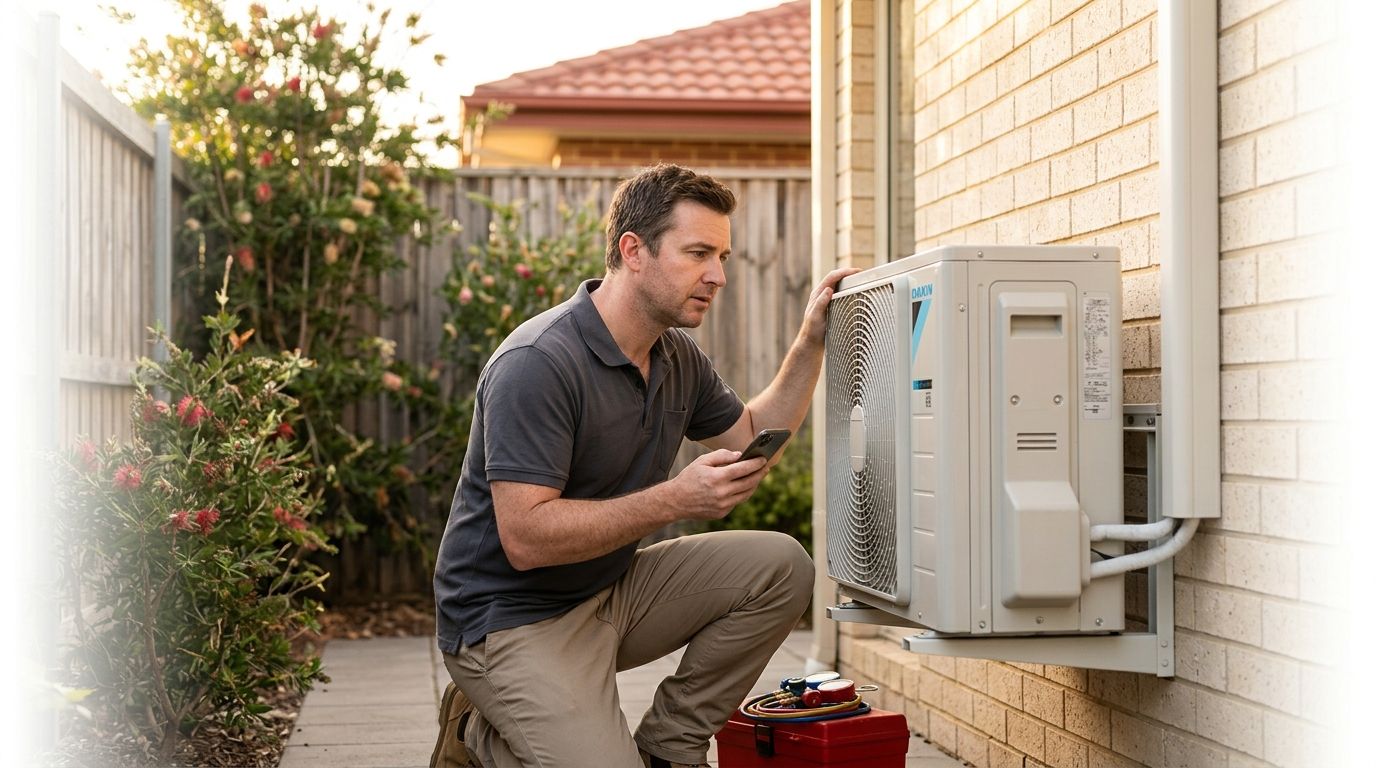
You walk into the room, the air conditioner has stopped working, and there's a blinking light or an unfamiliar code on the display. It's a frustrating moment, but that code is actually useful information. Daikin air conditioner error codes are the system's built-in self-diagnostic language, designed to pinpoint exactly what has gone wrong rather than leaving you guessing. Knowing how to read them can save you an unnecessary service call or, at the very least, help you describe the problem accurately when you do call a technician.
This article covers the most common Daikin error codes in a quick-reference table, explains what causes each fault, walks through which fixes are safe to attempt yourself, and tells you clearly when the job needs a licensed technician.
Key takeaways
Daikin air conditioners communicate faults in two main ways depending on the model: LED flash sequences on wall-mounted units and alphanumeric codes on ducted controller displays. Both systems carry the same goal of telling you exactly which component or circuit has triggered a fault, but they look quite different in practice. Understanding which system your unit uses is the first step to making sense of what you're seeing.
On most wall-mounted split systems, the indoor unit has two indicator lights labelled 'OPERATION' and 'TIMER'. When a fault occurs, these lights flash in a specific pattern. You count the number of flashes from each light, note them as a pair (for example, three flashes on OPERATION and five flashes on TIMER), and cross-reference that combination against the fault code table in your installation manual. The outdoor unit also has its own indicator light, and in some faults both indoor and outdoor codes need to be read together to identify the problem correctly.
On ducted systems and some newer wall units, the controller display shows a letter-number code directly, such as 'E3', 'U4' or 'F3'. These are much quicker to read and leave less room for miscounting. Some Daikin remote controls also allow you to retrieve stored fault codes through a diagnostic mode, though the exact button sequence varies by model. If you're unsure how to navigate your remote's functions more broadly, the Daikin air con remote symbols explained guide is a good place to start.
Newer Daikin models compatible with the Daikin Online Controller app can push error notifications directly to your smartphone, so you may receive an alert before you even notice the unit has stopped. This is particularly handy for ducted systems installed in roof spaces where the indoor unit isn't visible day to day.
Older Daikin models, generally those installed before the mid-2010s, rely on LED blink patterns to communicate faults. You watch the 'OPERATION' and 'TIMER' lights, count each light's flashes separately, and use that two-number combination to look up the fault. It takes a bit of patience, especially if the unit is cycling through a long sequence, but the information is all there once you know what to count.
Newer models with a digital display on the wall controller or remote show alphanumeric codes directly. These are faster to read and easier to search. If you're not sure which system your unit uses, check the label on the indoor unit's front panel or look up your model number on the Daikin Australia website. Your installation manual will also include the full fault code table specific to your unit, and it's worth keeping a copy somewhere accessible for exactly this kind of situation.
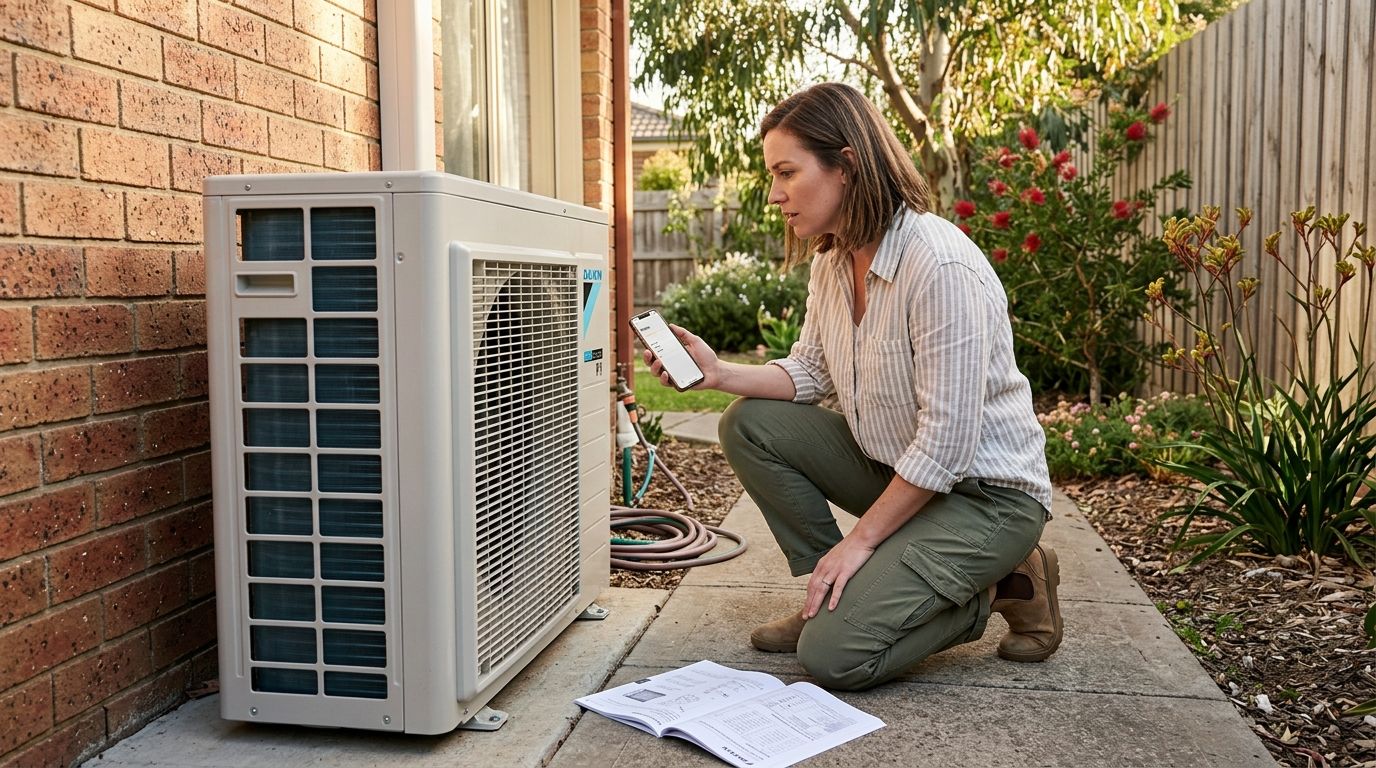
The table below covers the most common Daikin air conditioner error codes you're likely to encounter on wall-mounted split systems like the Daikin Cora (for example, the FTXM25Y 2.5kW) and on ducted systems. Each code is listed with its fault description, the most likely cause, and whether it's safe to address yourself or whether you need to call a licensed technician.
| Error Code | Fault Description | Likely Cause | DIY or Call a Tech? |
|---|---|---|---|
| E1 | Indoor PCB fault | Failed or damaged printed circuit board inside the indoor unit | Call a tech |
| E3 | Indoor fan motor fault | Fan motor failure, wiring fault or blocked airflow | Call a tech |
| E4 | Drain sensor fault / water overflow | Blocked condensate drain line or dirty drain pan | DIY (see steps below) |
| E5 | Outdoor unit overcurrent | Compressor drawing excessive current, electrical fault or refrigerant issue | Call a tech |
| E7 | Outdoor fan motor fault | Fan motor failure, debris obstruction or capacitor fault | Call a tech |
| E9 | Electronic expansion valve fault | Faulty EEV coil, wiring issue or refrigerant flow problem | Call a tech |
| F3 | Discharge pipe temperature too high | Low refrigerant charge, blocked condenser or compressor fault | Call a tech |
| U0 | Refrigerant shortage | Refrigerant leak or undercharge from installation | Call a tech |
| U2 | Power supply voltage fault | Mains voltage too high or too low, or internal power supply failure | Call a tech |
| U4 | Communication error between indoor and outdoor units | Wiring fault, power interruption or PCB issue | DIY reset first (see steps below) |
| U9 | Communication error with central controller | Wiring fault, incorrect address settings or controller failure | Call a tech |
These codes can vary slightly between Daikin product series. The Cora, Alira X, Zena and ducted iSmartECOi ranges each have their own installation manual with a fault code table specific to that model. The table above covers the most common codes across the current Daikin lineup, but your unit's installation manual is always the definitive reference. If you've misplaced yours, Daikin Australia's website has downloadable manuals searchable by model number.
If you also own a Fujitsu unit, see our guide to Fujitsu air conditioner error codes for a similar reference.
Most Daikin error codes require a licensed technician, but a handful can be resolved at home with simple steps. The three situations below are safe for a homeowner to attempt: clearing a blocked drain (E4), resetting a communication error (U4) and performing a general power-cycle reset when the unit is unresponsive. None of these involve opening the unit, touching electrical components or handling refrigerant.
For broader troubleshooting beyond error codes, see our guide on how to fix an air conditioner.
Any fault code involving refrigerant, electrical components or motor failures must be handled by a licensed technician. This covers E1 (indoor PCB), E3 (indoor fan motor), E5 (outdoor overcurrent), E7 (outdoor fan motor), E9 (expansion valve), F3 (discharge pipe temperature), U0 (refrigerant shortage) and U2 (power supply voltage). Attempting to diagnose or repair these faults yourself is illegal under Australian refrigerant handling regulations, and doing so will void your Daikin warranty. Daikin's warranty is typically five years on parts and labour when the system is installed by an authorised dealer, and that protection is worth keeping intact.
Frozone Air technicians are licensed and experienced across all current Daikin product lines, including the Cora (such as the FTXM25Y 2.5kW), the Alira X and the ducted iSmartECOi series. If your unit is showing a code that isn't on the DIY list above, the safest and most cost-effective move is to book a professional repair rather than risk further damage. You can book our air conditioning repairs service online, and we'll send a technician who already knows your system.
Most Daikin error codes are preventable with routine maintenance. Keeping filters clean, the outdoor unit clear and the system professionally serviced once a year will significantly reduce the frequency of faults like E3, E4, E5, E7 and F3, and it will extend the working life of your unit considerably.
Filter cleaning is the single most impactful thing you can do yourself. During heavy use periods, such as peak summer or winter, clean or rinse your filters every four to six weeks. Clogged filters restrict airflow across the evaporator coil, which forces the fan motor to work harder (raising E3 and E4 risk) and causes the discharge pipe temperature to climb (raising F3 risk). Most Daikin filters slide out without tools and can be rinsed under a tap and left to dry before reinserting.
The outdoor unit needs attention too. Keep the area around it clear of leaves, grass clippings and any stored items. Daikin recommends a minimum clearance of 30 centimetres on the sides and 60 centimetres at the front for adequate airflow. Blocked airflow around the outdoor unit is a leading cause of E5 overcurrent and E7 fan motor faults, particularly during hot weather when the unit is already working at capacity.
An annual professional service is the most reliable way to catch problems before they become fault codes. A licensed technician will check refrigerant levels, inspect electrical connections, clear the condensate drain line and test the system's operating pressures. Book an air conditioning service before the start of summer or winter, not after the first fault appears.
If your system supports remote monitoring, use it. The Daikin Online Controller app connects to compatible models including the ducted iSmartECOi series and sends fault notifications directly to your phone. Catching an early warning before the system shuts down completely gives you time to book a service rather than an emergency repair.
To reset a Daikin error code, turn the unit off at the remote, then switch off the dedicated circuit breaker at your switchboard and leave it off for 30 seconds before restoring power. This clears the fault memory on both the indoor and outdoor control boards. If the same code returns after the reset, the underlying fault has not been resolved and a technician needs to investigate.
E3 on a Daikin air conditioner indicates an indoor fan motor fault. The most common causes are a failed fan motor, a wiring fault in the motor circuit, or severely restricted airflow caused by a blocked filter. E3 is not a DIY repair as it involves internal electrical components, so a licensed technician will need to diagnose and replace the faulty part.
A recurring error code means the root cause has not been fixed, only the symptom has been cleared. A power-cycle reset will clear the code temporarily, but if the fault condition still exists the unit will detect it again and shut down. Recurring codes like U4, F3 or U0 almost always point to a wiring fault, refrigerant issue or failing component that needs professional diagnosis rather than repeated resets.
In most cases, no. Daikin units are designed to shut down or restrict operation when a fault code is active, specifically to prevent further damage to the compressor or other components. Running a unit through a fault condition, particularly codes like F3 or U0, can cause serious and expensive damage. The safest approach is to leave the unit off until the fault has been properly diagnosed and repaired.
Daikin error codes are a genuinely useful diagnostic tool. They narrow down the fault, help you decide whether a quick reset will do the job, and give a technician a clear starting point when they arrive. Most faults, caught early, are straightforward to fix and far less expensive than leaving a problem to worsen.
That said, the majority of codes point to faults that need a licensed technician to resolve safely and legally. If your unit is still showing a code after working through the steps in this guide, the right move is to book a professional rather than push the system further.
Frozone Air services all current Daikin models across Sydney. You can book a repair or service online, call us on 1300 801 839, or browse our Daikin range if the fault has you thinking an upgrade might be the smarter long-term call. We're here to help you get comfortable again quickly.