

Does Your Air Conditioner Need Aircon Ventilation? What Homeowners Should Know
Confused about aircon ventilation? Learn how split systems, ducted AC and evaporative coolers handle fresh air — and what you actually need to do at home.


Confused about aircon ventilation? Learn how split systems, ducted AC and evaporative coolers handle fresh air — and what you actually need to do at home.

Most homeowners assume their air conditioner is pulling in fresh air from outside. It's one of the most common misconceptions in home comfort, and it's easy to see why. The outdoor unit is right there, humming away, so surely some of that outside air must be making its way in? The reality is that aircon ventilation works very differently to what most people expect. The vast majority of residential systems, particularly split systems, simply recirculate the air already inside your home.
This article covers what ventilation actually means in an air conditioning context, which system types do and don't bring in outside air, and what you can do as a homeowner to keep your indoor air quality healthy. By the end, you'll have a clear picture of what your system is actually doing and where you might need to take extra steps.
Key takeaways
Air conditioning and ventilation are two separate functions that are often lumped together. Air conditioning controls the temperature and humidity of the air inside your home. Ventilation is the process of exchanging that indoor air with fresh outdoor air. A system can do one, both, or neither, and most residential air conditioners only do the first.
Mechanical ventilation uses fans or ducted systems to actively move air between inside and outside. Natural ventilation relies on openings like windows, doors and vents to let air flow through a building. Both approaches achieve the same goal: diluting stale indoor air, reducing CO2 build-up and flushing out pollutants. Standard split systems do neither of these things.
The confusion around 'aircon ventilation' is understandable. Marketing language often blurs the line, and terms like 'fresh feel' or 'clean air mode' on modern units refer to filtration and ionisation, not actual air exchange. Filtering the air inside your home is genuinely useful, but it is not the same as bringing in outside air.
A split system air conditioner does not ventilate a room. It conditions the air already in the room by drawing it across an evaporator coil, cooling or heating it through a refrigerant cycle, and blowing it back into the space. The outdoor unit expels or absorbs heat through a separate coil, but no air passes between the indoor and outdoor units.
The wall penetration that connects the two units carries refrigerant lines, a power cable and a condensate drain pipe. That hole is sealed around the pipes with foam or putty. No air travels through it in either direction. The outdoor unit is doing thermodynamic work, not acting as an air intake.
This means the air in your room is being continuously filtered and reconditioned, but the same body of air keeps circulating. If someone is cooking, smoking or if there are off-gassing materials in the room, a split system will not dilute those pollutants with fresh air. It will simply keep moving them around, though a good filter will capture some particles in the process.
Ducted reverse-cycle systems also recirculate indoor air by default. The return air grilles pull air from inside the home, condition it, and push it back through the supply ducts. However, some ducted systems can be configured with a fresh-air damper, which allows a controlled percentage of outside air to be mixed in. This is more common in commercial installations but is available as an option for residential ducted setups. If you want to understand how ducted air conditioning works in more detail, it's worth reading up before deciding on a system type.
Evaporative coolers are a genuinely different story. They work by drawing hot outside air through water-saturated pads, which cools the air through evaporation before it is blown into the home. Because they are constantly introducing outside air, they require windows or vents to be partially open so the air can escape. This makes evaporative coolers a form of mechanical ventilation in their own right, though they only cool (they cannot heat) and they perform poorly in humid conditions. For Australian homeowners in dry inland climates, this is a meaningful distinction worth factoring into any system choice.
A split system air conditioner does not need a vent to the outside to operate, but the outdoor unit does require adequate clearance and airflow around it to function properly. This is not 'ventilation' in the indoor air quality sense. It is a physical installation requirement. The outdoor condenser needs room to expel heat, and if that airflow is blocked, the system will struggle. The indoor unit has no such requirement and needs no connection to outside air whatsoever. For a full breakdown of where to position your outdoor unit, the outdoor AC unit placement guide covers everything you need to know.
The outdoor condenser unit works by pushing heat from inside your home out into the surrounding air. To do that effectively, it needs unobstructed airflow on all sides. Most manufacturers specify a minimum of 30 cm of clearance on the sides and rear of the unit, and at least 60 cm of clear space in front of the discharge outlet where the fan expels air. These figures vary slightly between brands, so always check the installation manual for your specific model.
Restricted airflow forces the compressor to work harder to achieve the same result. That means higher electricity bills, more wear on internal components and a shorter overall lifespan for the unit. In extreme cases, a boxed-in outdoor unit can overheat and trigger a thermal protection shutdown, leaving you without cooling on the hottest days of the year.
Common culprits include garden enclosures built around the unit for aesthetic reasons, fences placed too close, dense shrubs growing up around the unit and recessed wall cavities with insufficient depth. A licensed installer carrying out your air conditioning installation Sydney will assess the proposed location against manufacturer specifications and Australian Standards before committing to a position, which is one of the key reasons professional installation matters beyond just the refrigerant work.
Because most split systems recirculate indoor air rather than introducing fresh air from outside, maintaining good indoor air quality requires a few deliberate habits. The good news is that most of these steps are simple, low-cost and take very little time. Combining regular filter maintenance, brief daily ventilation and periodic professional servicing will keep your air clean and your system running efficiently.
A clogged filter is one of the most common causes of poor indoor air quality in homes with split systems. When the filter is blocked with dust, pet hair and debris, airflow through the unit drops significantly. The system then recirculates whatever air it can pull through, which may include mould spores and fine particles that a clean filter would have captured. Over time, a dirty filter also allows contaminants to build up on the evaporator coil itself, compounding the problem.
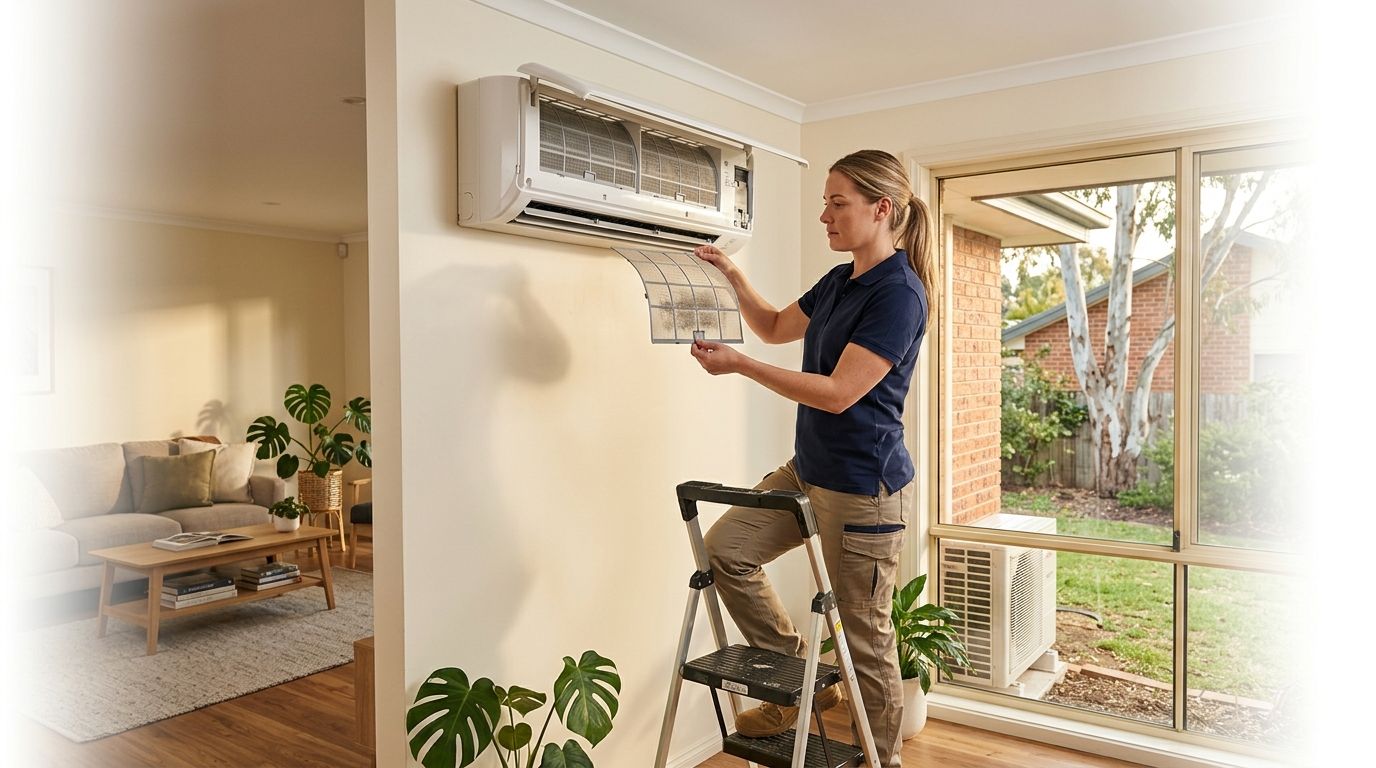
Most split systems use reusable mesh filters that can be removed, rinsed under a tap and left to dry before being reinstalled. During peak summer or winter use, aim to do this every four to six weeks. If your unit uses disposable filters, follow the manufacturer's replacement schedule rather than waiting until the filter looks visibly dirty. This single maintenance task has a bigger impact on air quality and running efficiency than almost anything else a homeowner can do.
Filter cleaning handles the surface layer of contamination, but it does not address what builds up deeper inside the unit over time. The evaporator coil, drain pan and blower wheel all accumulate dust, mould and bacteria that a standard filter clean will not touch. Mould growth on the evaporator coil is particularly common in humid climates and can cause musty odours and airborne spores to circulate through your home every time the system runs.
A professional air conditioning cleaning service removes these contaminants using specialised equipment and cleaning agents, restoring airflow and eliminating the biological build-up that DIY maintenance cannot reach. For most households, an annual service is sufficient. If you live in a humid coastal area, have pets or run your system almost continuously, every six months is a more appropriate interval. Frozone Air's cleaning service covers the full internal clean, including coil, drain pan and blower wheel, so the unit is back to performing as it should.
If you haven't installed a system yet, factoring in ventilation from the start is much easier than retrofitting a solution later. All modern split systems recirculate and filter indoor air effectively, but none of them introduce fresh air on their own. Knowing that upfront lets you plan for supplementary ventilation rather than discovering the gap after installation.
Three systems Frozone Air regularly installs are worth considering at the 2.5kW entry point. The Daikin Cora 2.5kW (FTXM25WVMA), from approximately $999, is a reliable all-rounder with multi-layer filtration and strong energy efficiency ratings, making it a solid choice for living areas and bedrooms alike. The Mitsubishi Electric MSZ-AP25VGD 2.5kW, from approximately $1,099, steps up with a more advanced filtration system that captures finer particles, which is particularly useful in homes with allergy sufferers or pets. The Fujitsu ASTG09KMCA 2.5kW, from approximately $949, is a compact and notably quiet unit well suited to bedrooms where noise levels matter.
All three are high-efficiency inverter split systems that will condition and filter your indoor air well. The honest trade-off is that none of them ventilate in the true sense. They will not dilute CO2 build-up or flush out volatile organic compounds from new furniture or fresh paint.
Homeowners in very airtight or newly built homes should raise this directly with their installer before committing to a system. A fresh-air intake damper on a ducted system, or a standalone heat recovery ventilator (HRV), can be planned alongside the air conditioning installation rather than added as an afterthought. To see the full range of split systems Frozone Air installs, browse our split system range and filter by capacity and brand to find the right fit for your space.
No. The vast majority of residential air conditioners, including all standard split systems and most ducted reverse-cycle systems, recirculate the air already inside your home. The outdoor unit expels or absorbs heat but does not pass any air into the indoor space. If you want fresh air exchange, you need to open windows or install a dedicated ventilation system such as an HRV or ERV.
A split system does not need a vent to the outside to operate. The indoor unit requires no connection to outdoor air at all. The outdoor condenser unit does need adequate clearance around it so it can expel heat effectively, but this is an installation clearance requirement, not ventilation in the air quality sense. Portable air conditioners are the exception as they do require an exhaust hose vented to the outside.
Not on its own. A split system filters and recirculates indoor air, which improves air quality to a degree, but it does not exchange that air with fresh outdoor air. To properly ventilate your home, open windows for at least 10 to 15 minutes daily, or install a mechanical ventilation system. Some ducted air conditioning systems can be fitted with a fresh-air damper that mixes a controlled amount of outside air into the return air stream.
No. Air conditioning controls the temperature and humidity of indoor air. Ventilation is the process of replacing stale indoor air with fresh outdoor air. The two functions are often confused because they both relate to indoor comfort, and some systems handle both. Standard residential air conditioners only handle the first. Evaporative coolers are an exception as they continuously draw in outside air, making them a form of mechanical ventilation as well as a cooling method.
Most residential air conditioners recirculate indoor air rather than ventilating in the traditional sense. With the right habits, regular filter maintenance and professional servicing, indoor air quality can remain healthy without a dedicated ventilation system. The real 'ventilation' requirement for the system itself comes down to outdoor unit placement and clearance, not any connection to outside air for the indoor unit.
If you are planning a new installation or want to get more out of your existing system, the best starting point is a conversation with a qualified installer who can assess your space, your climate zone and your air quality needs together. Frozone Air installs and services air conditioning systems across Sydney, and the team can advise on system selection, outdoor unit placement and whether supplementary ventilation is worth considering for your home.
To book a service or request a free installation quote, call Frozone Air on 1300 801 839 or get in touch through the website. Getting the right advice before you commit saves time, money and a lot of second-guessing later.