

Where Is the Best Place to Install an Outdoor AC Unit? A Guide to Outdoor AC Unit Placement
Get outdoor AC unit placement right the first time. Learn where to position your outdoor unit for efficiency, longevity, and noise compliance in Australia.


Get outdoor AC unit placement right the first time. Learn where to position your outdoor unit for efficiency, longevity, and noise compliance in Australia.
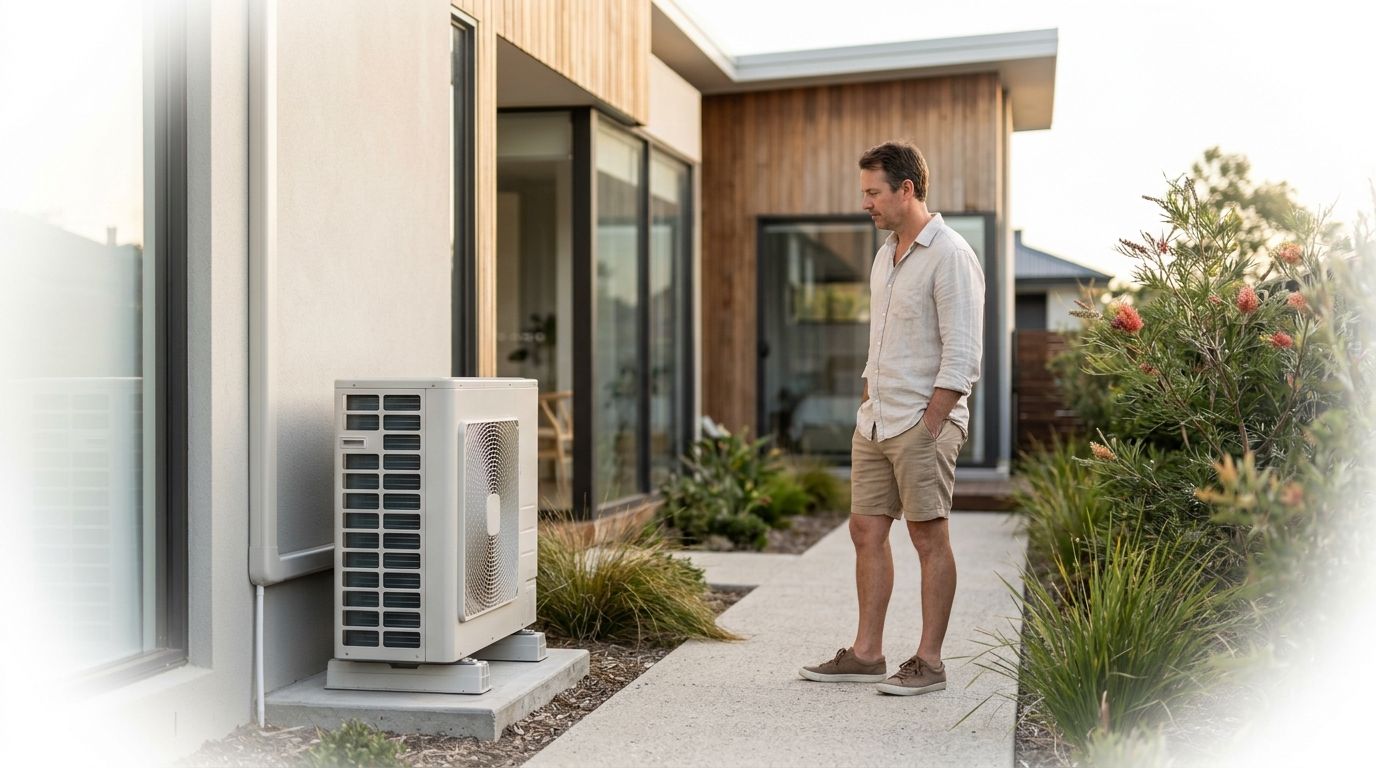
Most homeowners spend considerable time choosing the right indoor unit, picking the right capacity and deciding where it looks best on the wall. The outdoor unit, though, often gets placed wherever is convenient. Outdoor AC unit placement is just as critical as any other part of the installation, and getting it wrong can cost you real money in higher energy bills, more frequent repairs and a shorter system lifespan.
The position of your outdoor unit affects how hard the compressor works, how much heat it can shed, how much noise reaches your neighbours and how easy it is for a technician to service. This article covers the five factors that matter most: sunlight exposure, airflow clearance, proximity to trees and water, noise and accessibility. Get these right from the start and your system will run efficiently for years.
Key takeaways
Choosing where to mount your outdoor unit is not a decision to leave until the day of installation. A licensed installer should assess your property and walk through these five rules before any work begins. If you are planning a new system, discussing placement early gives you more options and avoids costly relocations later. For professional advice tailored to your home, speak to a team that specialises in split system air conditioning installation before you commit to a position.
Direct sunlight heats the condenser coil inside your outdoor unit, which forces the compressor to work harder to shed heat. The harder the compressor works, the more electricity it draws and the faster its components wear out. Over a full Australian summer, this adds up to noticeably higher running costs and a shortened unit lifespan.
In Australia, north and south-facing walls are generally the best options. North-facing walls receive morning and afternoon sun at lower angles, while south-facing walls stay shaded for most of the day. East and west-facing walls cop the harshest direct sun during summer, making them the least ideal positions. A shaded spot under an eave or pergola can also work well, provided the structure does not restrict airflow around the unit.
Your outdoor unit pulls in air, passes it over the condenser coil to release heat and then discharges that hot air outward through the front fan. If anything blocks that airflow, the unit cannot shed heat efficiently and will overheat, triggering safety shutdowns or running at reduced capacity.
Most manufacturers require at least 30 cm of clearance on the sides and rear of the unit, and between one and 1.5 metres of clear space in front of the discharge fan. Fences, walls, dense shrubs and garden screens are common culprits that restrict airflow in residential installations. Always check the specific brand's installation manual for exact clearance requirements, as they vary between models and can affect warranty validity if not followed.
Leaf litter, dust, grass clippings and dirt all find their way into the condenser fins over time, reducing airflow and forcing the unit to work harder. A unit positioned near a garden bed, under a deciduous tree or beside a driveway will clog up faster and need more frequent cleaning to maintain efficiency.
Pooling water is an equally serious concern. Moisture sitting around the base of the unit can corrode the casing, damage electrical components and encourage mould growth inside the coil. Avoid low-lying spots where rainwater collects after heavy downpours. If ground-level installation is unavoidable, a raised wall bracket or a solid concrete pad will keep the unit clear of debris and standing water, and is well worth the small additional cost.
Outdoor units typically produce between 50 and 65 dB during operation, which is roughly equivalent to a normal conversation or a running dishwasher. That level of noise is manageable in most situations, but it becomes a problem if the unit sits directly outside a neighbour's bedroom window or right up against a shared fence line.
Australian councils have noise regulations that apply to air conditioning units, and a complaint from a neighbour can result in fines or a forced relocation of the unit. A good installer will factor this in when recommending a position. If noise is a genuine concern for your property, quieter models are worth considering. The Daikin Cora Series, including models like the FTXM25Y, is a strong option, with outdoor compressor noise levels that make it well suited to placement near shared boundaries.
A unit that is difficult to reach is a unit that costs more to service. Technicians need enough clear space to safely remove access panels, inspect refrigerant lines, check electrical connections and clean the condenser coil. If your unit is wedged into a tight corner, boxed in by a fence or hidden behind a locked gate, every service call takes longer and costs more.
Poor access can also create warranty complications. Some manufacturers include minimum access requirements in their installation terms, and if those conditions are not met, a warranty claim may be disputed. Plan for at least enough space for a technician to work comfortably on all sides of the unit, and make sure the area remains accessible year-round, not just at the time of installation.
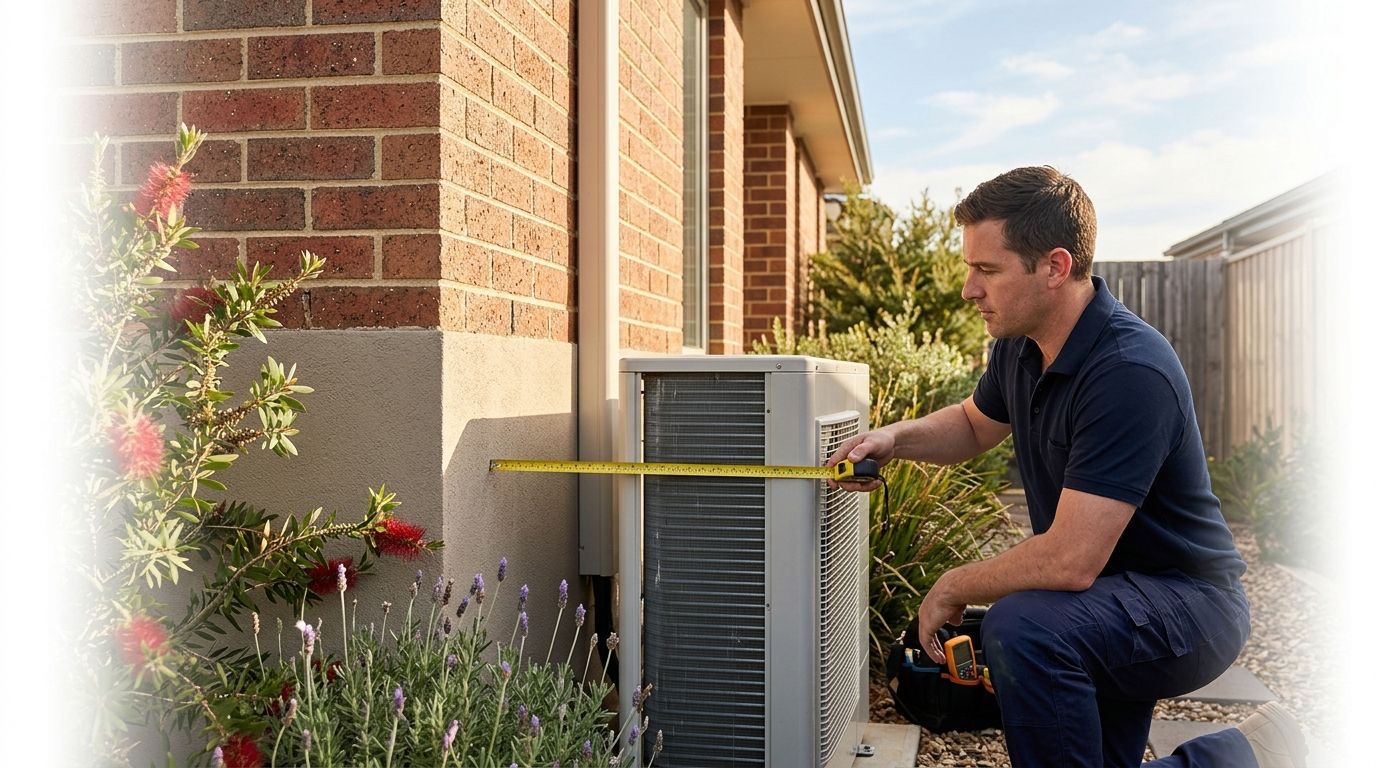
In Australia, wall orientation has a direct impact on how hard your outdoor unit works, particularly through summer. North-facing walls receive the most sun year-round due to Australia's position in the southern hemisphere, making them a poor default choice for outdoor unit placement in most states. South-facing walls are generally the coolest and most consistent option, while east and west-facing walls each come with their own trade-offs.
The table below gives you a quick reference for each orientation. Keep in mind these are general rules based on typical Australian conditions, and local factors can shift the picture considerably.
| Wall Orientation | Sun Exposure | Suitability for Outdoor Unit | Notes |
|---|---|---|---|
| North-facing | High year-round | Poor | Receives direct sun for most of the day in all seasons. Avoid unless well shaded by an eave or structure. |
| South-facing | Low and consistent | Best | Stays shaded for the majority of the day. The most stable thermal environment for the compressor. |
| East-facing | Morning sun only | Good | Morning sun is less intense than afternoon sun. A reasonable option if south is not available. |
| West-facing | Harsh afternoon sun | Poor | Cops the hottest sun of the day in summer. The worst orientation in most Australian states. |
These rules hold true across most of Australia, but they are not absolute. A north-facing wall that sits in permanent shade from a neighbouring building or a large established tree may actually outperform an unshaded south-facing wall. This is exactly why a proper site assessment matters. Wall orientation is one of several factors a licensed installer assesses before drilling, and readers wanting the full installation picture can follow our guide on how to install a split system aircon for a broader look at what the process involves.
The most costly outdoor AC unit placement mistakes are not the obvious ones. They are the decisions that seem fine at the time but create ongoing problems with efficiency, noise, warranty claims and council compliance. Here are the five mistakes Frozone Air technicians see most often in the field, and what to do instead.
A unit tucked into a small enclosed courtyard or wedged under a low-clearance deck has nowhere to discharge its heat. The hot air it expels simply recirculates back into the intake, causing the compressor to work harder and harder against rising ambient temperatures. This is one of the fastest ways to shorten a unit's lifespan and push up your running costs. If a courtyard or undercover area is your only option, the space needs to be genuinely open on at least one side with clear discharge space in front of the fan.
Older timber and weatherboard walls amplify compressor vibration in a way that brick and concrete simply do not. What starts as a faint hum can become an intrusive rattle that travels through the wall and into the rooms behind it. Anti-vibration mounts help, but they do not fully solve the problem if the wall itself is thin or hollow. A solid masonry surface is always the preferred mounting point for the outdoor unit bracket.
Ground-level installations are convenient, but they expose the unit to leaf litter, grass clippings, pooling water and the occasional curious animal. In areas that experience heavy rainfall or flooding, a unit sitting at ground level can be submerged or seriously damaged in a single weather event. A raised wall bracket or a solid elevated pad keeps the unit clear of debris and standing water, and is a straightforward fix that pays for itself quickly.
Every extra metre of refrigerant pipe between the indoor and outdoor unit adds resistance to the refrigerant circuit and reduces system efficiency. Most residential installations work best with a pipe run under 10 metres, and runs beyond 15 to 20 metres can noticeably reduce cooling and heating capacity while also increasing the cost of the installation itself. If the only viable outdoor location requires a very long pipe run, it is worth discussing with your installer whether a different indoor unit position or a different system type makes more sense. Before committing to a location, it pays to think through all the relevant considerations, which is why we recommend reading through the factors to consider before a split system air conditioner installation.
Apartments, townhouses and properties within strata schemes often have specific rules about where outdoor units can be placed, how they must be screened and what noise levels are acceptable. Installing a unit in a non-approved location can result in a notice to relocate it at your own expense, which is a costly and avoidable problem. Check with your strata manager or local council before installation, not after.
Across all of these scenarios, the common thread is following manufacturer specifications. Brands like Daikin, Fujitsu and Mitsubishi Electric all publish minimum installation clearance specs in their manuals. The Mitsubishi Electric MSZ-AP Series, for example, includes strict clearance requirements that a licensed installer will follow to maintain warranty validity. The same applies to the Fujitsu ASTG Series and Daikin's range. A licensed installer knows these specs and will flag any site conditions that put your warranty or system performance at risk before the job starts.
Outdoor AC unit placement comes down to five things: a shaded wall, adequate airflow clearance, a clean and dry environment, noise-aware positioning and easy access for servicing. Get all five right and your system will run efficiently for well over a decade. Get them wrong and you are looking at higher running costs, more frequent breakdowns and a unit that fails years before it should.
Poor placement is one of the most common and most preventable causes of reduced efficiency and premature unit failure. The good news is that it costs nothing to get it right at the planning stage, and everything to fix it after the fact.
If you are planning a new installation, the best first step is a proper site assessment by a licensed technician. Request a free quote through our air conditioning installation in Sydney service page and a Frozone Air technician will assess your property and recommend the best placement before any work begins. Prefer to talk it through first? Call us on 1300 801 839 for honest, no-pressure advice.
The outdoor unit is almost always mounted directly on an exterior wall of the house, not away from it. The key clearance rules apply around the unit itself: allow at least 30 cm on the sides and rear, and 1 to 1.5 m of unobstructed space in front of the discharge fan. If the unit sits on a ground pad, keep it at least 30 cm from the wall to allow airflow behind the condenser coil. Always check the manufacturer's installation manual for model-specific requirements.
The $5,000 rule means you multiply the age of your unit in years by the quoted repair cost. If the result exceeds $5,000, replacing the unit is generally the smarter financial decision. For example, a 10-year-old system with a $600 repair quote gives $6,000, which points toward replacement. This is a rule of thumb, not a hard law, so a technician's assessment of the unit's overall condition should also factor into your decision.
There are several locations to avoid for the outdoor unit: west-facing walls that cop intense afternoon sun, fully enclosed spaces like courtyards or under low decks, areas prone to water pooling or flooding, directly beside a neighbour's bedroom window and unstable surfaces such as old weatherboard walls. For the indoor unit, avoid positioning it above doorways where airflow is disrupted, or in a room where the unit is undersized for the space.
Most manufacturers specify a minimum of 10 to 30 cm between the back of the outdoor unit and the wall it is mounted on, to allow adequate airflow through the rear of the condenser coil. The exact distance varies by brand and model, with Daikin, Mitsubishi Electric and Fujitsu all publishing these specs in their installation manuals. A licensed installer will always follow these clearance requirements as part of a compliant installation.