

How Does Evaporative Air Conditioning Work? (And Is It Right for You?)
Wondering how does evaporative air conditioning work? We explain the science, pros, cons, and whether it suits your Australian home.


Wondering how does evaporative air conditioning work? We explain the science, pros, cons, and whether it suits your Australian home.
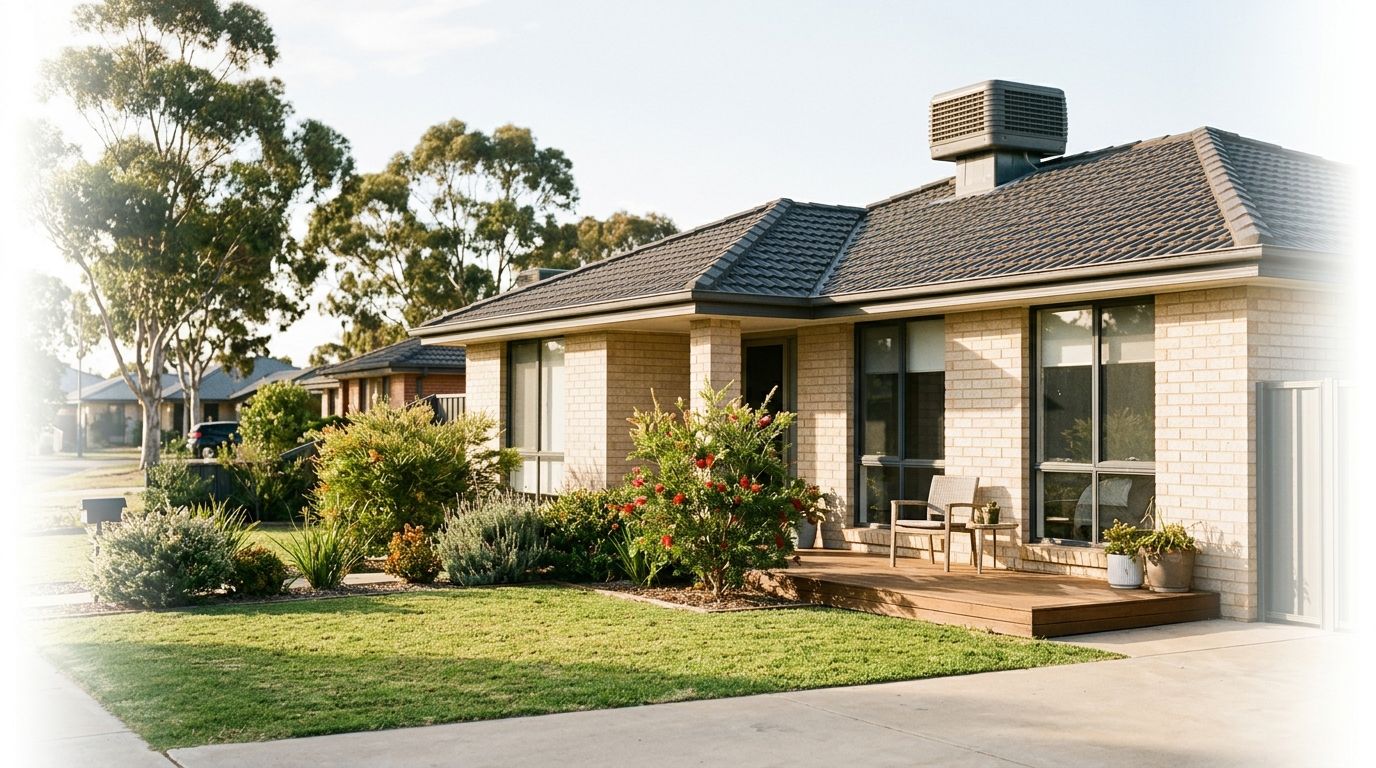
Australian summers are no joke. When the mercury climbs past 38°C and your electricity bill is already making you wince, the idea of a cooling system that costs a fraction of a standard air conditioner to run is genuinely appealing. Evaporative air conditioning works by drawing warm outside air through water-saturated pads, causing the water to evaporate and absorb heat, then pushing the cooled, fresh air through your home. It is a simple principle, and for the right climate, it works brilliantly.
This article covers the science behind evaporative cooling, the honest pros and cons, and how to work out whether it suits your home and location.
Key takeaways
Evaporative cooling relies on one of the most basic principles in physics: when water evaporates, it absorbs heat from the surrounding air. The same effect you feel stepping out of a pool on a hot day is what an evaporative cooler replicates at scale, dropping air temperature by roughly 5 to 15°C depending on how dry the outside air is.
The key variable is humidity. The drier the air, the more readily water evaporates, and the greater the temperature drop. This is why evaporative coolers perform exceptionally well in dry inland climates like Canberra, Adelaide and much of regional Victoria, but struggle on humid coastal days when the air is already close to saturation.
The cooling pads, sometimes called media or wet pads, are the heart of the system. They are typically made from cellulose or synthetic fibre and are kept continuously wet by a small pump that circulates water from a reservoir. As warm air is drawn through these pads by a fan, the water evaporates into the airstream, absorbing heat and lowering the air temperature before it enters your home.
One thing that catches people off guard: you must leave windows or vents open when running an evaporative cooler. Unlike a refrigerative system that recirculates the same air in a sealed space, an evaporative cooler needs a continuous flow of fresh air through the building. Without an exit path, the humidity builds up quickly and the cooling effect disappears.
Here is how the full cooling cycle works, step by step:
Most Australian homes with evaporative cooling use a rooftop ducted system. These units sit on the roof and distribute cooled air through ceiling vents across multiple rooms, making them a practical whole-home solution. They are the dominant choice in Melbourne and regional Victoria, where the dry summer climate suits them well. A ducted evaporative system can cover a large home from a single rooftop unit, and running costs are significantly lower than ducted refrigerative systems.
Portable and window-mounted evaporative coolers are the other option. These are self-contained units that cool a single room and require no professional installation. They are far less powerful than a ducted system and work best in small, well-ventilated spaces. For cooling more than one or two rooms reliably, a ducted system is the more practical choice.
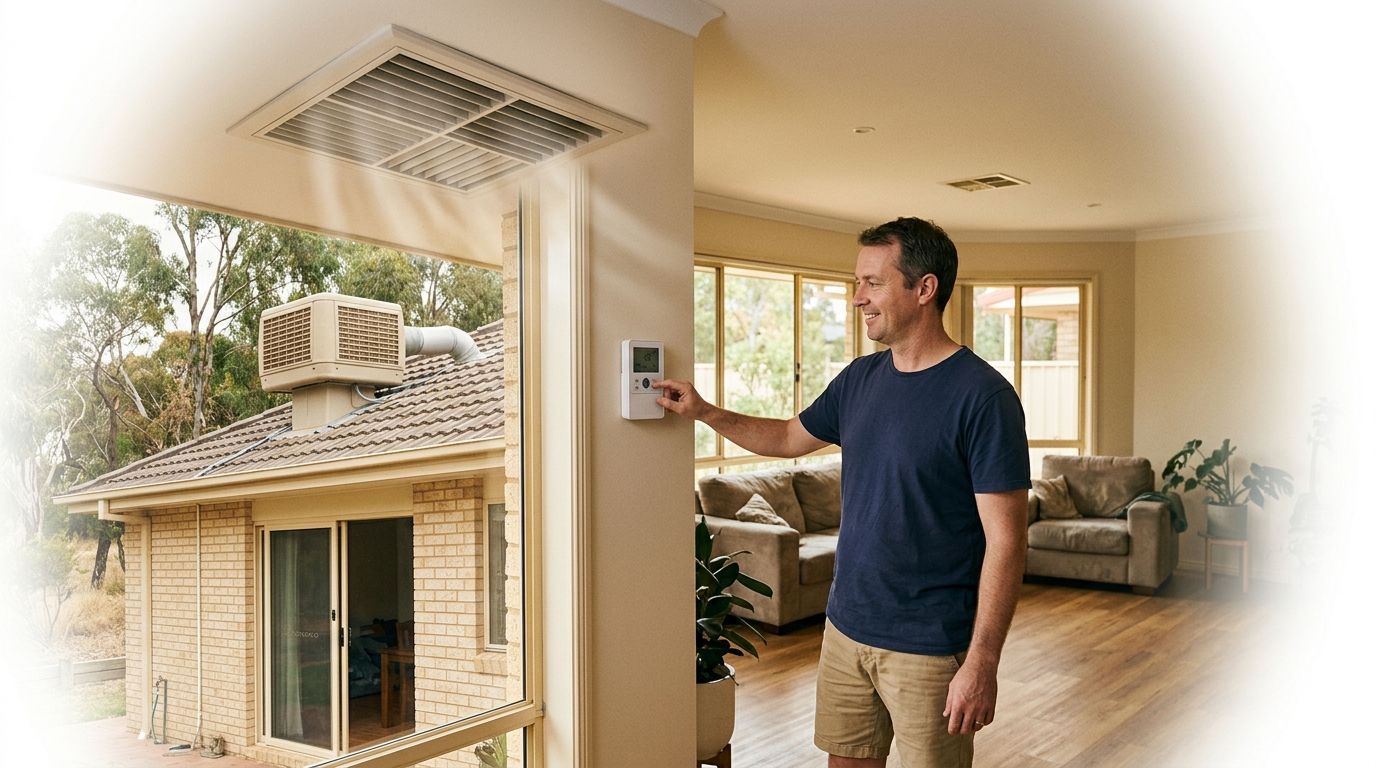
Evaporative cooling has genuine strengths, but it is not the right fit for every home or every climate. Understanding both sides honestly is the best way to decide whether it suits your situation. The advantages are most compelling in dry inland areas, while the disadvantages become deal-breakers in humid coastal cities.
For a full side-by-side breakdown, see our guide to evaporative cooling vs air conditioning.
Evaporative cooling is an excellent choice for the right home in the right climate, but a poor one for the wrong combination of both. Three factors determine whether it will work well for you: where you live, how your home is laid out, and what your budget and comfort priorities are.
Evaporative cooling works best when outdoor relative humidity stays below 50 to 60%. In practice, this means it excels in dry inland cities and regions: Canberra, Adelaide, Perth, Mildura, Dubbo and much of regional Victoria and New South Wales. In these areas, summer days are hot and dry, and an evaporative system can drop indoor temperatures by a meaningful margin.
The picture is very different on the coast. Sydney, Brisbane, Darwin and Wollongong all experience summer humidity levels that regularly exceed 60 to 70%, particularly during heatwaves. In these cities, evaporative cooling underperforms precisely when you need it most. Frozone Air services both Sydney and Melbourne, and we are straightforward with Sydney customers: for most Sydney homes, evaporative cooling is not the right call. A reverse-cycle refrigerative system will keep you comfortable regardless of what the humidity is doing outside.
The physical layout of your home has a direct impact on how well an evaporative system performs. Open-plan homes with multiple windows, sliding doors or ceiling vents allow the warm, humid exhaust air to escape efficiently, which keeps the cooling cycle working properly. The more freely air can move through and out of the building, the better the result.
Poorly ventilated homes, or rooms with few openable windows, will feel stuffy rather than cool. The humid air has nowhere to go, so it accumulates and the temperature barely drops. Ducted evaporative systems can zone airflow to different parts of the house, but every zone still needs an exhaust path. If your home is tightly sealed or has limited window access, a refrigerative system will serve you far better.
Upfront costs favour evaporative cooling. A ducted evaporative system typically costs $3,000 to $8,000 fully installed, compared to $5,000 to $15,000 or more for a ducted refrigerative system of equivalent coverage. Combined with the lower running costs, the savings over several years can be substantial. For a detailed breakdown of supply and installation costs, see our guide on how much evaporative air conditioning costs in Australia.
The trade-off is versatility. Evaporative systems cannot heat, so homeowners in Canberra or alpine Victoria will still need a separate heating solution for winter. If year-round comfort from a single system is the goal, a reverse-cycle split system or ducted refrigerative system is the practical answer. Systems like the Daikin Cora (2.5kW FTXM25YVMA), the Mitsubishi Electric MSZ-AP Series (2.5kW MSZ-AP25VGD) and the Fujitsu ASTG Series (3.5kW ASTG12KMTC) heat and cool year-round from a single wall-mounted unit, making them a strong alternative for homeowners in humid climates or those who want one system to handle all seasons.
If you live in a dry climate and want low running costs, evaporative cooling is hard to beat. If you are in Sydney or another humid coastal city, a reverse-cycle system will serve you better year-round.
Yes, evaporative air conditioning is significantly cheaper to run than a refrigerative split system. Evaporative coolers typically use 80 to 90% less electricity, costing around $0.10 to $0.20 per hour compared to $0.50 or more per hour for a reverse-cycle split system. The savings are most pronounced in dry climates where the system runs at full efficiency all summer.
Evaporative cooling generally does not work well in Sydney. Sydney's summer humidity regularly exceeds 60 to 70%, which prevents effective water evaporation and sharply reduces the cooling effect. On the hot, humid days when you need cooling most, an evaporative system will struggle to deliver meaningful relief. A reverse-cycle refrigerative system is a far more reliable choice for Sydney homes.
Yes, you must leave windows or vents open when running an evaporative cooler. The system continuously pushes fresh, humidified air into your home, and that air needs an exit path. Without open windows, humidity builds up rapidly inside the house and the cooling effect disappears. Aim to open windows in rooms you want to cool and leave them slightly ajar rather than fully open.
An evaporative cooler should be serviced at least once a year, ideally before the start of summer. A standard service includes cleaning or replacing the cooling pads, flushing the water reservoir and distribution system, and checking the pump and fan motor. Neglecting maintenance leads to mineral build-up, reduced airflow and, in some cases, bacterial growth in the water system.
Evaporative air conditioning is a cost-effective, eco-friendly option for homeowners in dry climates, but it has real limitations in humid conditions and cannot heat your home in winter. Choosing the right system comes down to your climate, your home's layout and your budget. There is no single answer that fits every household.
Frozone Air installs and services split systems and ducted refrigerative systems across Sydney and Melbourne. If you are unsure whether evaporative cooling or a reverse-cycle system is the right fit for your home, our team can walk you through the options based on your specific situation. Ready to find the right system? Book an installation quote with the Frozone Air team, or browse our split system range to see the brands and models we install, including the Daikin Cora, Mitsubishi Electric MSZ-AP Series and Fujitsu ASTG Series. You can also reach us directly on 1300 801 839.