

AirTouch Smart Controller Review: Is It Worth It for Your Ducted System?
Thinking about an AirTouch controller for your ducted system? Read our honest review covering features, costs, AirTouch 2 Plus vs 5, and whether it's worth it.


Thinking about an AirTouch controller for your ducted system? Read our honest review covering features, costs, AirTouch 2 Plus vs 5, and whether it's worth it.
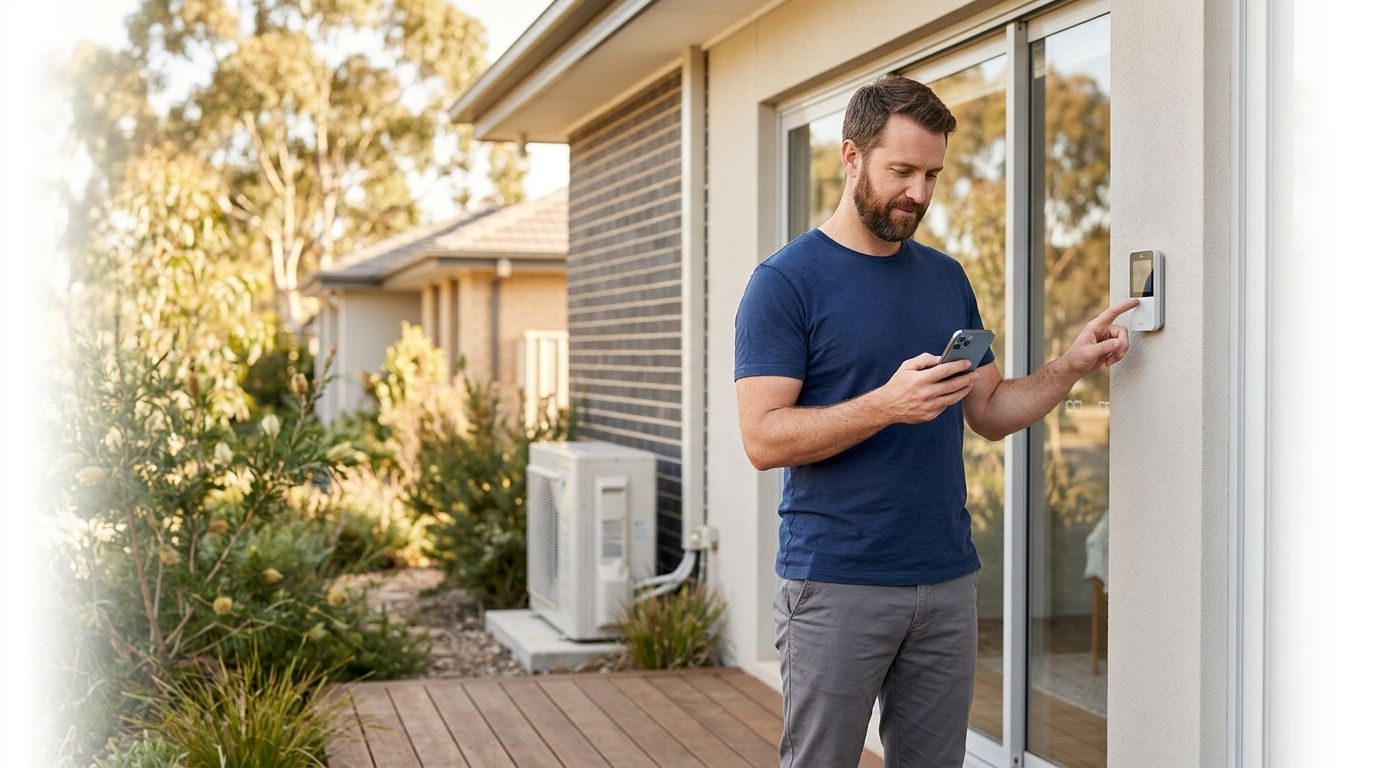
An AirTouch controller is a smart zone-control system made by Polyaire that sits on top of an existing ducted air conditioning system. Rather than replacing your entire unit, it replaces the standard wall controller with a touchscreen console and a companion smartphone app, giving you per-room temperature control, scheduling, geofencing and energy monitoring from a single interface. The air touch controller itself communicates with motorised dampers already installed in your ductwork, opening and closing them to direct conditioned air only where it is needed.
The system works by pairing the wall-mounted console with a small control module wired into your existing ducted unit. Wireless temperature sensors placed in individual rooms report actual room temperatures back to the controller, so the system responds to real conditions rather than a single return-air reading. You can manage everything from the touchscreen at home or through the AirTouch app on your phone, wherever you are.
AirTouch is compatible with most major ducted brands sold and installed in Australia, including Daikin, Mitsubishi Electric, Fujitsu and ActronAir. It does not require a full system replacement, which makes it a practical upgrade for homeowners who already have a ducted system but want smarter, more granular control over how and where they use it.
Key takeaways
The AirTouch range, particularly the flagship AirTouch 5, offers a significant step up from the basic zone controllers that come bundled with most ducted systems. The features below cover what the system actually does day to day, along with a few honest caveats worth knowing before you commit.
Zone control is the core function of any AirTouch system. Motorised dampers in the ductwork open or close on a per-room basis, so you are only conditioning the spaces you are actually using. The AirTouch 5 supports up to 16 zones and can even manage two separate ducted units from a single controller, which suits larger homes with zoned systems across multiple floors or wings.
What separates AirTouch from cheaper zone controllers is the optional wireless temperature sensors. Most basic zone systems rely on a single return-air sensor near the indoor unit, which gives a rough average of the whole home rather than an accurate reading for any individual room. AirTouch's wireless sensors sit inside each zone and report actual room temperatures back to the controller. The system then modulates the dampers to hit your target temperature in each space rather than just running until the return-air sensor is satisfied.
More sensors mean more accurate control and, in practice, greater energy savings. A bedroom that reaches its set temperature early will have its damper closed automatically, redirecting airflow to rooms that still need it. The trade-off is cost: sensors are an additional expense on top of the controller itself, and you will need a licensed technician to position them correctly for reliable readings.
The AirTouch app is available on both iOS and Android and connects to your home Wi-Fi to give you full remote control of the system. From the app you can adjust zone temperatures, switch the system on or off, set weekly schedules and receive push notifications if your home temperature drifts outside a range you define. The 8-inch HD touchscreen on the AirTouch 5 wall console mirrors most of these controls for anyone who prefers a physical panel.
Geofencing is one of the more practical features for busy households. Using your phone's location, the app can automatically turn the system off when you leave a defined boundary around your home and turn it back on as you approach. This removes the need to remember to switch off the air conditioning when you head out, which adds up to real savings over a year of use.
For voice control, AirTouch 5 works with both Google Assistant and Amazon Alexa, so you can adjust temperatures or switch zones with a voice command. The system also integrates with broader smart home platforms, making it a reasonable fit for homes already running Google Home or Amazon Echo devices. It is worth noting that Apple HomeKit is not natively supported at the time of writing, so iPhone-heavy households may find the integration less complete than they would like.
The table below summarises the two current AirTouch models side by side:
| Feature | AirTouch 5 | AirTouch 2 Plus |
|---|---|---|
| Wall console display | 8-inch HD touchscreen | Smaller touchscreen console |
| Maximum zones | 16 zones, 2 AC units | 8 zones, 1 AC unit |
| Smartphone app | iOS and Android | iOS and Android |
| Wireless temperature sensors | Yes (optional add-on) | Yes (optional add-on) |
| Geofencing | Yes | Yes |
| Voice control | Google Assistant, Amazon Alexa | Google Assistant, Amazon Alexa |
| Energy monitoring | Yes | Basic |
| Approx. installed price | $1,200 to $1,800 | $800 to $1,200 |
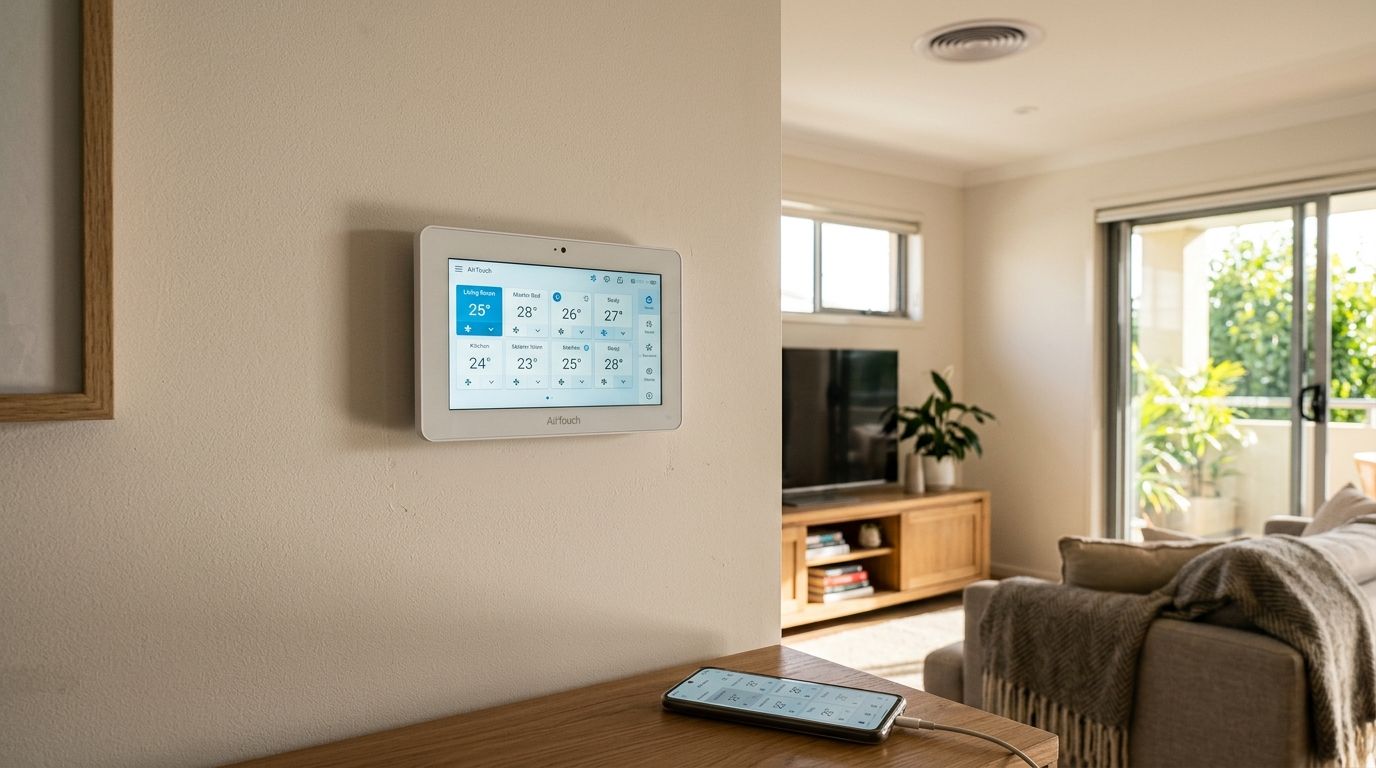
The AirTouch range currently has two active models: the entry-level AirTouch 2 Plus and the flagship AirTouch 5. Both are made by Polyaire and offer app control, zone management and wireless sensor compatibility, but they differ meaningfully in screen size, zone capacity and smart home depth. The right choice comes down to the size of your home and how much of the smart-home ecosystem you actually want to use.
| Feature | AirTouch 2 Plus | AirTouch 5 |
|---|---|---|
| Screen size | Smaller touchscreen console | 8-inch HD touchscreen |
| Max zones supported | 8 zones | 16 zones |
| Max AC units supported | 1 | 2 |
| Wireless sensors included | Optional add-on | Optional add-on |
| App control | iOS and Android | iOS and Android |
| Voice control | Google Assistant, Amazon Alexa | Google Assistant, Amazon Alexa |
| Smart home integration | Basic | Broader platform support |
| Approx. installed price | $800 to $1,200 | $1,200 to $1,800 |
The AirTouch 2 Plus suits smaller homes with up to eight zones and households that want smarter control without paying for features they will not use. The AirTouch 5 is the better fit for larger homes, multi-storey properties or anyone running two separate ducted units who wants a single point of control. If you are already thinking about the broader cost of your ducted setup, our guide to ducted air conditioning costs in Australia gives useful context on where a smart controller sits within the overall system investment.
AirTouch is a genuinely useful upgrade for the right home, but it is not the right call for every ducted system. The honest answer depends on how many zones you have, how varied your household's schedule is, and whether you will actually use the app features day to day. For homes that tick those boxes, the running cost savings and comfort improvements are real. For simpler setups, the upfront spend may not pay off.
AirTouch delivers its strongest return in larger homes where multiple zones are running at different times. A household where one person works from home in a study while others are out, or where bedrooms are only occupied at night, can make meaningful savings by conditioning only the rooms in use rather than the whole house. The more zones you have and the more varied your daily routine, the faster the controller pays for itself through lower running costs.
Understanding how much power your air conditioner uses is a useful starting point before calculating potential savings. A high-capacity ducted system running at full load across an entire home consumes significantly more electricity than one that is actively managed by zone. Pairing AirTouch with an energy-efficient ducted system from a brand like Daikin or Mitsubishi Electric maximises that benefit, since you are combining a high-efficiency unit with precise zone-level control rather than relying on one or the other alone.
Multi-storey homes and properties with distinct living zones, such as a separate guest wing or a granny flat connected to the main system, are also strong candidates. The AirTouch 5's ability to manage two ducted units from a single controller makes it particularly practical in those situations.
AirTouch is harder to justify in smaller homes with only two or three zones. At that scale, the difference between conditioning the whole house and conditioning a couple of rooms is modest, and the $800 to $1,800 installed cost of the controller takes much longer to recover through energy savings alone.
Renters are also not good candidates. AirTouch requires a licensed technician to wire the control module into the ducted unit and install motorised dampers, which means permanent modifications to the property. Most landlords will not approve that kind of work, and it is not a system you can take with you when you move.
Households that prefer a simple set-and-forget approach should also think carefully before committing. The energy savings AirTouch promises depend heavily on residents actively using the zone scheduling and app features. If the system ends up running on a single fixed schedule with all zones open, it will behave much like a standard controller. Most modern ducted systems already include basic zone switching and a seven-day timer via the standard wall controller, which covers the needs of many households without any additional spend.
AirTouch is compatible with most major ducted air conditioning brands sold in Australia, including Daikin, Mitsubishi Electric, Fujitsu and ActronAir. Before purchasing, you should confirm compatibility with your specific model, as some older or less common units may not be supported. A licensed technician can check this during a pre-installation assessment.
No. AirTouch requires a licensed electrician or air conditioning technician to wire the control module into your ducted unit and configure the zone dampers. DIY installation is not permitted under Australian electrical regulations and would void the product warranty. Always use a qualified installer.
The AirTouch 2 Plus supports up to eight zones from a single ducted unit. The AirTouch 5 supports up to 16 zones and can manage two separate ducted units from one controller, making it the better choice for larger or multi-storey homes.
Yes. The wall-mounted touchscreen console operates independently of your home Wi-Fi, so you can still control zones and adjust temperatures locally if your internet goes down. Remote access via the smartphone app does require an active Wi-Fi connection.
It can, but the savings depend on how actively you use the zone scheduling and geofencing features. Homes with four or more zones and varied daily routines typically see the strongest results. Running all zones on a fixed schedule with no active management will produce minimal savings compared to a standard controller.
The AirTouch controller is a well-engineered upgrade for larger Australian homes with existing ducted systems. Used properly, it delivers genuine comfort improvements and measurable energy savings through precise zone control, smart scheduling and real-time monitoring. The AirTouch 5 suits homes with four or more zones and complex daily routines, while the AirTouch 2 Plus covers smaller setups at a lower entry price.
Before you buy, two things matter: confirming that your current ducted unit is compatible with AirTouch, and budgeting for professional installation. This is not a plug-in device. A licensed technician needs to wire the control module and configure your zone dampers correctly for the system to perform as advertised.
If you are considering a full system upgrade or starting from scratch, the team at Frozone Air can walk you through your options. Contact us for a free quote on ducted air conditioning installation or to find out whether AirTouch is the right fit for your current setup.