

Ceiling Cassette Air Conditioner: Pros, Cons and Is One Right for Your Home?
Thinking about a cassette air conditioner? We cover how they work, the real pros and cons, costs, and whether one suits your home. Expert advice from Frozone Air.


Thinking about a cassette air conditioner? We cover how they work, the real pros and cons, costs, and whether one suits your home. Expert advice from Frozone Air.
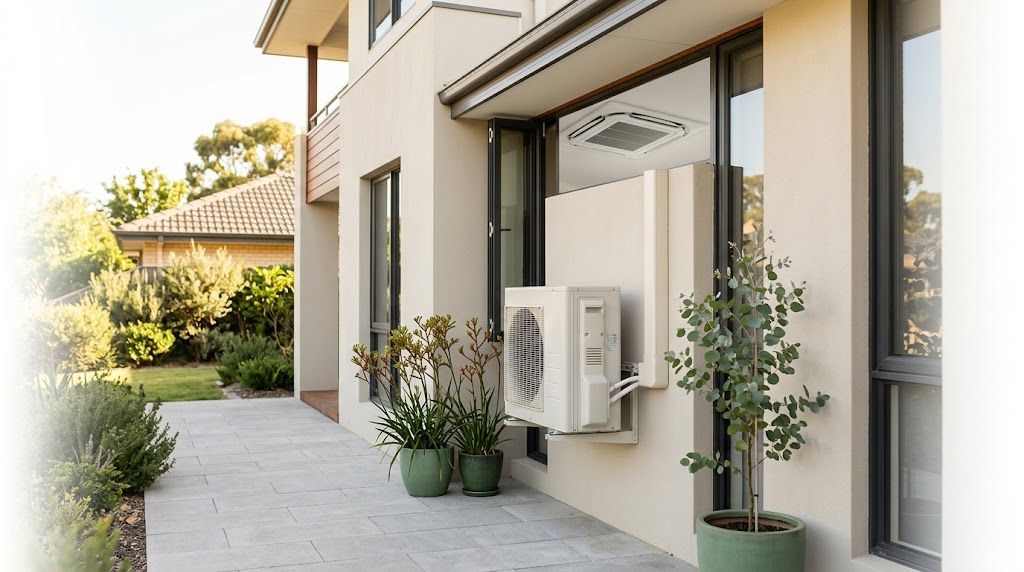
A cassette air conditioner is a type of split system where the indoor unit is installed inside a suspended or bulkhead ceiling, leaving only a square grille panel visible from below. Unlike a standard wall-mounted split system, which sits on the wall and takes up visible wall space, a cassette unit is almost entirely hidden above the ceiling line. This makes it a popular choice for homeowners and businesses that want effective climate control without a large white box dominating the room.
The key difference between a cassette and a fully ducted system is scale and complexity. A ducted system uses a network of ducts and vents to condition an entire home zone by zone, while a cassette unit conditions a single space from one central ceiling point. There is no ductwork involved beyond the refrigerant lines connecting the indoor and outdoor units.
Most cassette units distribute air in two or four directions from the centre of the ceiling panel. That multi-directional airflow makes them particularly well suited to open-plan living areas, large bedrooms, commercial offices and retail spaces where a single wall-mounted unit would struggle to reach every corner of the room.
Key takeaways
Cassette units offer genuine advantages over wall-mounted splits, particularly in larger or design-conscious spaces. Here is a look at the main benefits and what they mean in practice for an Australian home or business.
With a cassette unit, the only thing you see from inside the room is the grille panel, which typically measures around 600 x 600 mm and sits flush with the ceiling. There is no large white box mounted on the wall, no visible pipework running along the skirting, and no unit competing with your furniture or artwork for attention. For homeowners undertaking high-end renovations or fitting out open-plan living spaces, that level of discretion is a real advantage. Many architects and interior designers specify cassette units precisely because they disappear into the ceiling.
A four-way cassette distributes conditioned air outward in all four directions simultaneously from the centre of the room. This means the cool or warm air reaches every corner of the space rather than blowing in a single direction from one wall. Compare that to a wall-mounted split, which projects air across the room from one side and can leave the far end noticeably warmer or cooler. In a large open-plan kitchen and living area, that difference is significant. A centrally positioned cassette unit effectively eliminates the hot and cold spots that frustrate people with wall-mounted units in bigger rooms.
Because the bulk of the indoor unit sits above the ceiling panel, the ceiling itself acts as a natural sound barrier between the unit and the room below. Typical indoor noise levels for cassette units sit around 26 to 34 dB(A) depending on the model and fan speed setting, which is roughly equivalent to a quiet library or a soft whisper. That makes cassette units a solid choice for bedrooms, home offices and living areas where background noise from a wall-mounted unit can become irritating over time.
Leading cassette models from Daikin, Mitsubishi Electric and Fujitsu all use inverter compressors as standard. An inverter compressor modulates its output continuously to match the heating or cooling load of the room, rather than switching fully on and off like an older fixed-speed unit. The result is more stable temperatures, less energy wasted on start-up cycles and lower running costs over time. In terms of energy ratings, quality cassette units are directly comparable to premium wall-mounted inverter splits. For a deeper look at how to compare efficiency ratings across different system types, see our guide to the most energy-efficient air conditioners in Australia.
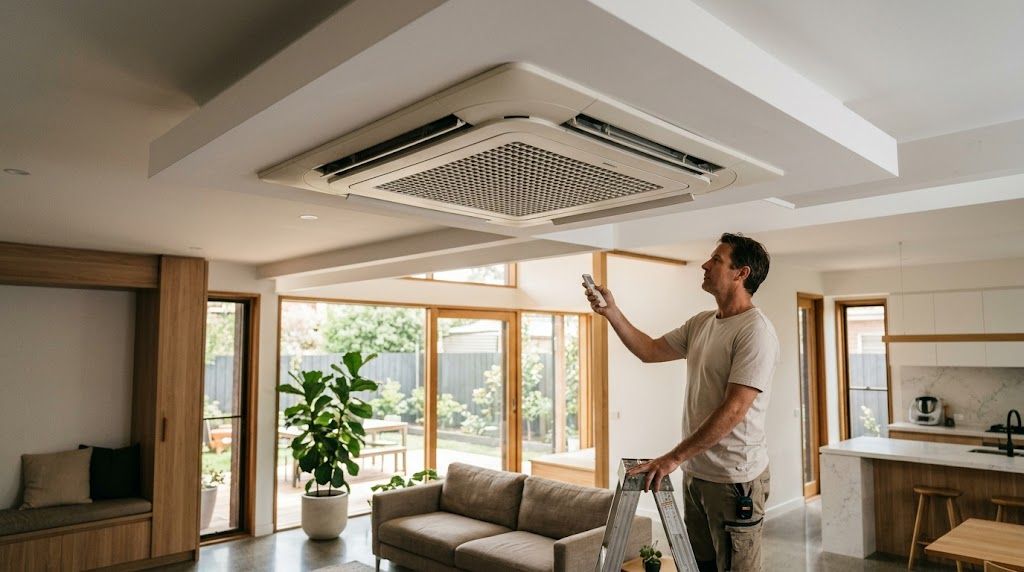
Cassette units are genuinely impressive pieces of kit, but they are not the right fit for every home or budget. Before committing to one, it pays to understand the real limitations so there are no surprises once the installer arrives on site.
A cassette unit will almost always cost more than a wall-mounted split of equivalent capacity, both for the unit itself and for the installation. The indoor unit is a more complex piece of equipment, and getting it into the ceiling requires additional labour, longer refrigerant line routing and careful condensate drain planning. Where a standard back-to-back split system installation might take a couple of hours, a cassette install typically takes a full day or more depending on ceiling access and site conditions. For a full breakdown of what to expect, see our guide to air conditioning installation costs in Australia.
Cassette units require a suspended or drop ceiling with enough cavity depth to house the indoor unit, typically at least 300 mm of clear space above the ceiling panel. Homes with concrete slab ceilings, very shallow roof cavities or no ceiling void at all may not be suitable without significant building work. This is one of the first things a Frozone Air technician will assess during a site visit, so it is worth raising early in the conversation before you fall in love with a particular model.
On a wall-mounted split, cleaning the filter is a two-minute job: you pop the front panel open and slide the filter out at eye level. With a cassette unit, the filters are accessed via the ceiling panel, which means reaching up overhead and working at height. It is not difficult, but it is less convenient. Some models, including certain Daikin and Mitsubishi Electric cassette units, include auto-cleaning filter functions that reduce how often you need to do it manually. For a practical walkthrough of the process, our guide on how to clean your air conditioner covers cassette filters alongside wall-mounted units.
Wall-mounted splits drain condensate down an external wall through a short drain line, which is straightforward to install. A cassette unit, sitting in the middle of the ceiling, needs a drain line routed through the ceiling cavity to reach an appropriate outlet such as an external wall, a drain point or a condensate pump. If this is not installed correctly, water can back up and leak through the ceiling panel, which is both damaging and frustrating. A licensed installer will plan the drain route as part of the job, so this is not something you need to solve yourself, but it does add to the complexity and cost of the installation.
Choosing between a cassette air conditioner and a wall-mounted split system comes down to your room size, ceiling type, budget and how much the aesthetics matter to you. The table below lays out the key differences side by side.
| Feature | Cassette AC | Wall-Mounted Split System |
|---|---|---|
| Upfront Unit Cost | Higher (typically $1,500 to $2,400+ for supply) | Lower (typically $700 to $1,800 for supply) |
| Installation Complexity | High. Ceiling work, longer line routing and condensate drain planning are required. | Low to moderate. Standard back-to-back installs are straightforward. |
| Ceiling Requirements | Suspended ceiling with at least 300 mm cavity depth required | No ceiling requirements. Mounts on any solid wall. |
| Airflow Direction | Two-way or four-way from the centre of the room | Single direction from one wall |
| Aesthetic Impact | Minimal. Only a flush ceiling grille is visible. | Moderate. A wall-mounted box is visible in the room. |
| Maintenance Access | Filters accessed via ceiling panel overhead | Filters accessed at eye level via front panel |
| Best Suited For | Large open-plan rooms, commercial spaces, design-conscious renovations | Bedrooms, smaller rooms, standard homes, tighter budgets |
A cassette unit is the stronger choice for large open-plan living areas, commercial offices, retail spaces and any renovation where aesthetics are a priority. If your home has a suitable suspended ceiling with adequate cavity depth, a centrally positioned cassette will deliver more even airflow and a far cleaner look than anything mounted on a wall. It is also worth considering if you are fitting out a new build or major renovation where the ceiling can be designed around the unit from the start.
For most standard bedrooms, smaller rooms or homes without a ceiling cavity, a wall-mounted split system is the more practical and cost-effective solution. Our split system air conditioning range covers a wide selection of inverter models from Daikin, Mitsubishi Electric and Fujitsu to suit rooms of every size. If you want to understand the full picture before deciding, our article on the wall-mounted air conditioner is a useful next read.
The three cassette models Frozone Air installs most often are the Daikin FCA Series, the Mitsubishi Electric PLA-M Series and the Fujitsu AUTG Series. All three are inverter-driven, available in a range of capacities and backed by strong manufacturer warranties. The right choice depends on your budget, the size of the space and how much you value features like ultra-quiet operation or advanced filtration.
The Daikin FCA Series (for example, the FCA50B at 5.0kW) is our go-to mid-range recommendation. Supply pricing sits around $1,500 to $2,000 for a 5.0kW unit, and Daikin backs it with a five-year warranty. The FCA Series carries strong energy ratings and Daikin's reputation for reliability makes it a solid choice for most residential and light commercial applications.
The Mitsubishi Electric PLA-M Series (such as the PLA-M50EA at 5.0kW) is the premium option. Supply pricing is typically around $1,800 to $2,400, and you get noticeably quieter operation than most competitors, along with advanced filtration that captures finer airborne particles. If you are fitting out a bedroom, a home office or a space where noise levels really matter, the PLA-M is worth the extra outlay.
The Fujitsu AUTG Series (for example, the AUTG18LVLA at 5.0kW) sits between the two on price, with supply pricing around $1,600 to $2,100. It is a strong performer in medium-to-large rooms and offers competitive efficiency ratings. For homeowners who want a reliable, well-specified unit without paying a premium brand price, the AUTG Series is a very capable choice.
All three models are available through Frozone Air, and our technicians install them regularly across Sydney. The best way to confirm which capacity and model suits your specific space is to have one of our licensed technicians assess your ceiling and room dimensions in person. Request a free quote or book a consultation through our air conditioning installation Sydney page, and we will take care of the rest.
A cassette air conditioner is an excellent choice for the right home and the right space. If you have a suspended ceiling with adequate cavity depth, an open-plan living area or a room where aesthetics genuinely matter, a cassette unit delivers discreet design, even four-way airflow and energy efficiency that matches the best wall-mounted inverter splits on the market. The trade-off is a higher upfront cost and a more complex installation compared to a standard wall-mounted system.
The honest answer to whether a cassette suits your home is that it depends on your ceiling. Not every home has the cavity depth or the ceiling type to make it work, and finding that out early saves a lot of frustration. The simplest next step is to have a licensed technician take a look.
To find out if a cassette unit is right for your space, call Frozone Air on 1300 801 839 or request a free quote online. We will assess your ceiling, measure the room and recommend the right capacity and model for your situation.
Cassette air conditioners are an excellent choice for the right space. They perform comparably to premium wall-mounted split systems in energy efficiency and cooling capacity, and their 360-degree airflow distribution makes them particularly well suited to large, open-plan rooms and commercial areas. They do require a suitable ceiling cavity, so they are not the right fit for every home.
Neither cassette AC nor split AC is universally better. The right choice depends entirely on your space. Cassette units suit larger rooms, open-plan areas and spaces where a discreet ceiling-mounted aesthetic matters, while wall-mounted split systems are more cost-effective and easier to install in standard bedrooms and smaller rooms. A professional assessment is the best way to determine which option suits your specific home.
The main disadvantages of cassette AC are higher upfront and installation costs compared to wall-mounted split systems, a requirement for a suitable ceiling cavity of at least 300 mm depth, and slightly more involved maintenance access. Because filters sit behind the ceiling panel rather than a front-facing cover, cleaning and servicing typically requires a technician rather than a quick DIY job.
The most common cassette AC problems are condensate drain blockages that cause water leaks, dirty or clogged filters that reduce airflow and efficiency, refrigerant leaks and uneven airflow if the unit is undersized for the room. The good news is that most of these issues are preventable with regular professional servicing before each cooling or heating season.