

Aircon Regas: What It Is, When You Need It and How Much It Costs in Australia
Wondering about aircon regas costs in Australia? Learn what regassing is, the signs your system needs it, and what you'll pay in 2025. Expert advice from Frozone Air.


Wondering about aircon regas costs in Australia? Learn what regassing is, the signs your system needs it, and what you'll pay in 2025. Expert advice from Frozone Air.
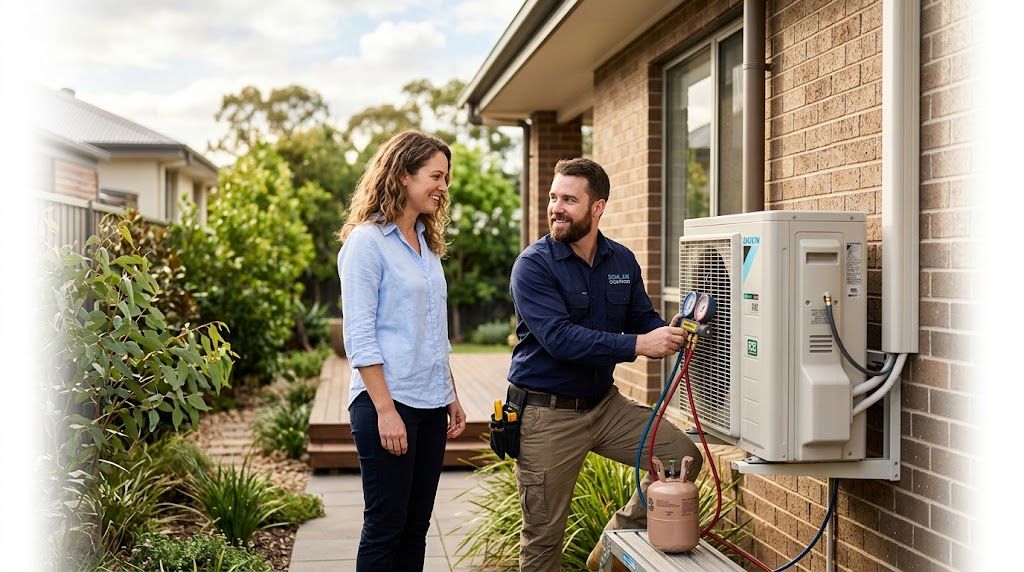
An aircon regas is the process of replenishing the refrigerant gas inside your air conditioning system. Refrigerant is the substance that makes cooling possible: it absorbs heat from the air inside your home, carries that heat to the outdoor unit, and releases it outside. Over time, small leaks or worn seals can cause refrigerant levels to drop, leaving your system struggling to cool effectively. This article covers what regassing actually involves, the signs that tell you it's time to book one, and what you can expect to pay in Australia.
For most homeowners, a regas is a rare service. A well-installed system with no leaks should hold its refrigerant charge for the life of the unit. Understanding what's involved means you won't be caught off guard if a technician recommends it.
Key takeaways
Refrigerant is the working fluid that makes your air conditioner function. It circulates continuously between the indoor and outdoor units in a closed loop, changing state between liquid and gas as it moves. This cycle transfers heat out of your home and relies on the compressor, evaporator coil and condenser coil all working together with the correct refrigerant charge.
Here is how the cycle works in simple terms. The refrigerant enters the indoor unit as a cold, low-pressure liquid. As warm room air passes over the evaporator coil, the refrigerant absorbs that heat and evaporates into a gas. The compressor then pressurises the gas and pushes it to the outdoor unit, where the condenser coil releases the heat into the outside air. The refrigerant cools back into a liquid and the cycle repeats.
One important point: refrigerant is not consumed like petrol in a car. It does not get 'used up' during normal operation. If your system is low on refrigerant, there is a leak somewhere in the system. Simply topping up the gas without finding and fixing the leak is a short-term fix at best. Any reputable technician will locate and repair the leak before regassing, otherwise you will be paying for the same service again within months.
The refrigerant type your system uses depends largely on when it was installed. There are three types you are likely to encounter in Australian homes, and they are not interchangeable.
Not sure which refrigerant your system uses? Check the data plate on the outdoor unit. The refrigerant type is printed there alongside the model number and electrical specifications.

Six warning signs commonly point to low refrigerant in a split system or ducted unit: warm air blowing on the coldest setting, the system running non-stop without reaching the set temperature, ice forming on the indoor coil or copper lines, hissing or bubbling sounds near either unit, a sudden rise in electricity bills and the outdoor compressor cycling on and off more frequently than usual. That said, each of these symptoms can also be caused by other faults entirely, so a professional diagnosis is always the right first step.
None of these signs are definitive proof that a regas is needed. Dirty filters, blocked coils, a failing capacitor or a faulty compressor can produce identical symptoms. Before assuming refrigerant is the problem, book a qualified technician to run a proper diagnosis. A good tech will pressure-test the system, check for leaks and measure the actual refrigerant charge before recommending any work. You can book an air conditioning repairs assessment with Frozone Air if you are based in Sydney and want a professional opinion before committing to any repair.
A standard aircon regas in Australia typically costs between $200 and $600 for a split system, and up to $900 or more for older systems running on phased-out R22 refrigerant. The exact price depends on the refrigerant type your system uses, the size of the unit and whether a leak repair is required on top of the regas itself.
| System Type | Refrigerant | Typical Regas Cost (AUD) | Notes |
|---|---|---|---|
| Split System (R32) | R32 | $200–$350 | Most common in homes built after 2018; lower GWP refrigerant, widely available |
| Split System (R410A) | R410A | $250–$400 | Common in systems installed 2000–2020; still straightforward to service |
| Ducted System | R32 or R410A | $350–$600 | Larger refrigerant volume required; cost scales with system capacity |
| R22 System | R22 | $500–$900+ | Phased-out gas, scarce and expensive; replacement is often the smarter option |
Most regas quotes from a reputable technician will include a call-out fee, a leak detection check, the refrigerant top-up itself and a basic system performance test once the charge is restored. These are the core components of the job, and a written quote should itemise each one clearly.
What is not always included is the cost of actually repairing the leak. If the technician finds a faulty valve, a cracked joint or a worn seal, fixing it typically involves soldering or component replacement, and that labour and parts cost is separate from the regas price. Depending on the complexity of the repair, this can add anywhere from $100 to $400 or more to the final bill.
Some technicians charge a standalone leak detection fee of $80 to $150. In many cases this fee is credited toward the repair if you proceed with the work, so it is worth asking upfront. Always request a written quote before any work begins. A reputable technician will not pressure you to proceed on the spot, and having the quote in writing protects you if the final invoice looks different from what was discussed.
For a broader look at what routine servicing and repairs typically cost, see our guide to air conditioner service prices in Australia.
If your system is more than 10 to 12 years old, the answer is not always yes. Age alone is not a reason to replace a unit, but it does change the maths on repair costs. An older system that needs a regas, a leak repair and possibly a compressor service is accumulating costs that can quickly approach the price of a new unit.
The calculation becomes even clearer if your system runs on R22. As covered earlier, R22 is expensive and increasingly hard to source. A regas on an R22 system can cost $500 to $900 or more, and there is no guarantee the leak will not return. At that price point, a new R32 split system starts to look like the better investment.
A modern replacement from a brand like Daikin or Mitsubishi Electric will also run significantly more efficiently than a system from the early 2000s. The Daikin Cora 2.5kW split system, for example, uses R32 refrigerant as standard and carries a strong energy star rating, meaning lower running costs from day one. The energy savings alone can offset a meaningful portion of the replacement cost over a few years of use.
That said, if your system is under 10 years old, uses R32 or R410A and has a single minor leak, a regas and repair is almost certainly the right call. Replacement makes sense when the repair cost exceeds roughly 50% of what a new equivalent unit would cost, or when the system has a history of repeated faults. For more guidance on this decision, see our article on when to replace your air conditioner.
DIY aircon regassing is illegal in Australia. Under the Ozone Protection and Synthetic Greenhouse Gas Management Act, only technicians holding an ARCtick refrigerant handling licence are permitted to purchase, handle and recharge refrigerants. Attempting to regas a system yourself can result in significant fines, and no reputable supplier will sell refrigerant to an unlicensed individual.
The legal issue is only part of the story. Getting the refrigerant charge wrong, whether too much or too little, puts serious strain on the compressor. An overcharged system forces the compressor to work against excessive pressure, while an undercharged system causes it to run hot and dry. Either way, compressor failure is a real risk, and a replacement compressor can cost as much as a brand new unit. On top of that, any DIY work on the refrigerant circuit will void the manufacturer warranty immediately.
There are also safety considerations. Refrigerants like R32 are mildly flammable, and handling them without the correct equipment and training creates genuine hazards. A licensed technician carries the right recovery cylinders, leak detection tools and pressure gauges to do the job safely and correctly.
Here is what a professional regas service actually involves:
That process is what separates a proper regas from a quick top-up. If a technician skips the leak detection and pressure test, that is a red flag worth taking seriously. You can book a professional air conditioning service with Frozone Air if you want the job done correctly from the start.
Aircon regassing is a repair, not routine maintenance, and it is always triggered by a refrigerant leak somewhere in the system. For most residential split systems, the cost sits between $200 and $600, and the work must be carried out by a licensed ARCtick technician. If your system is ageing, running on R22 or has a history of repeated faults, the repair bill can start to approach the cost of a new unit, and at that point replacement is often the smarter call.
Frozone Air installs and services all major brands across Sydney and Melbourne, including Daikin, Mitsubishi Electric and Fujitsu. The Mitsubishi Electric MSZ-AP Series and the Fujitsu ASTG Series are both strong performers with excellent energy ratings and full R32 refrigerant systems as standard. If you are weighing up repair versus replacement, our team can give you an honest assessment of whether your current system is worth saving.
To book a regas inspection, call us on 1300 801 839 and we will arrange a licensed technician to assess your system. If you are ready to explore a replacement, request a free installation quote and we will help you find the right unit for your home and budget.
Regassing your aircon typically costs between $200 and $350 for a standard split system using R32 or R410A refrigerant, rising to $350 to $600 for ducted systems due to the larger refrigerant volume involved. Older systems running R22 refrigerant cost significantly more because that refrigerant has been phased out and is now scarce. If a leak repair is also required, expect the final bill to be higher than a straightforward recharge alone.
A fair aircon regassing quote should include a call-out fee, leak detection, a refrigerant recharge to manufacturer specification and a post-service performance check. Be cautious of very cheap quotes that skip leak detection entirely, as topping up refrigerant without fixing the underlying leak is a short-term fix that will leave you back in the same position within months. A reasonable all-in price for a split system regas in Australia is $200 to $400.
Most Australian homeowners pay between $200 and $500 to regas a residential air conditioner, depending on the refrigerant type, system size and whether a leak repair is needed alongside the recharge. Ducted systems sit at the higher end of that range due to the greater volume of refrigerant required. Always get a written quote before any work begins so there are no surprises on the final invoice.